


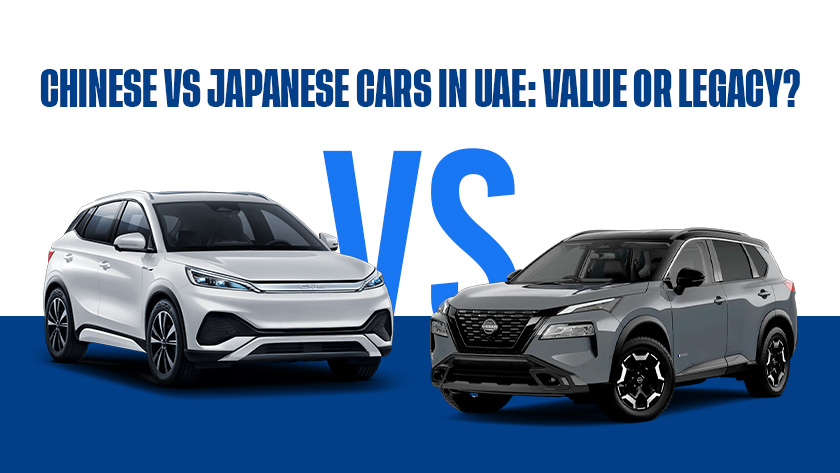
Chinese vs Japanese Cars in UAE: Value or Legacy?
A data-driven comparison of pricing, resale value, reliability and EV growth in the UAE automotive market.

The discussion around Chinese vs Japanese cars in the UAE has shifted from brand perception to ownership economics.
In 2026, buyers in the UAE car market are looking beyond badges. The comparison now revolves around measurable factors such as resale value, long-term cost profile, reliability in extreme heat, EV readiness, service infrastructure, and long-term financial stability.
This guide examines how Chinese and Japanese vehicles compare in pricing strategy, depreciation trends, resale performance, electrification progress, and ownership economics in the UAE automotive market.
Chinese Cars in UAE: Pricing, Features and EV Expansion
Over the past five years, Chinese manufacturers including BYD, Geely, Jetour, MG and Chery have expanded significantly across the UAE. Many of these brands now compete directly in mid-range SUV segments, hybrid crossovers and fully electric vehicles.
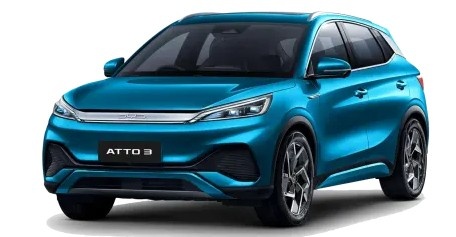
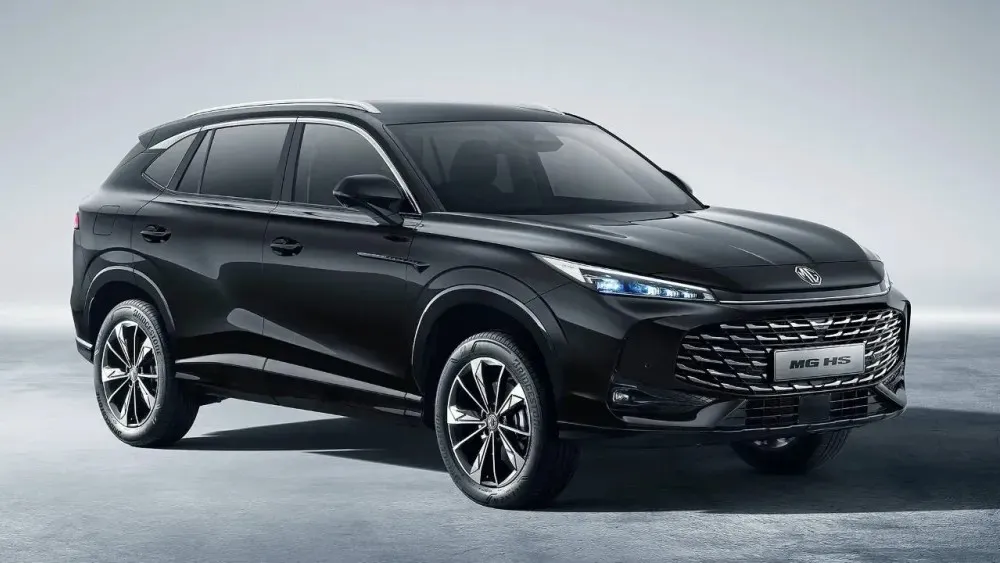
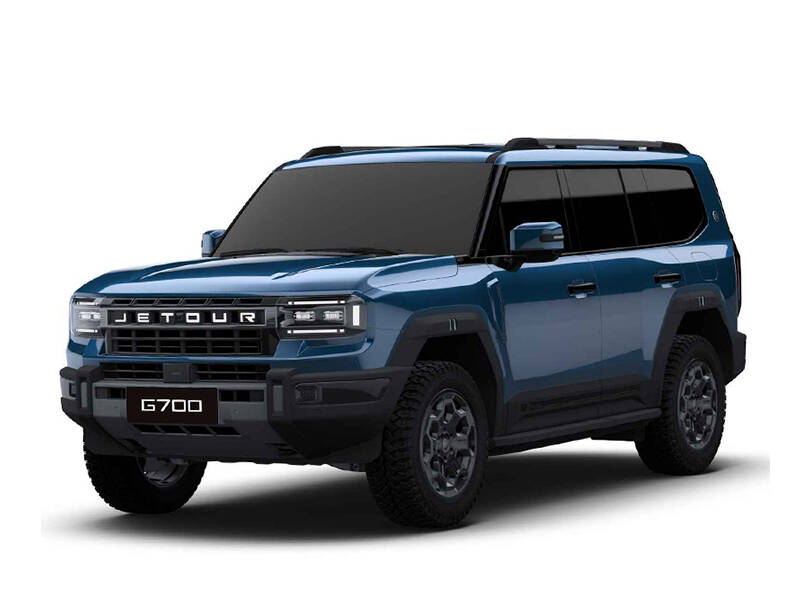
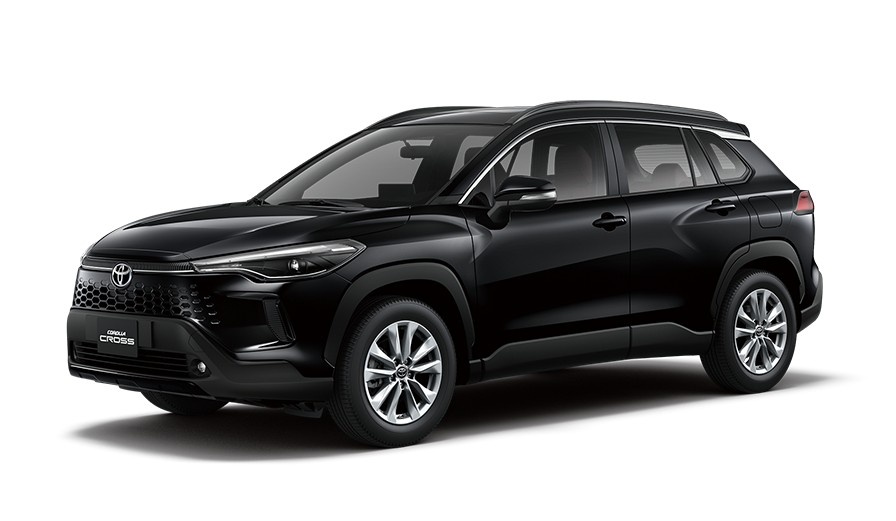
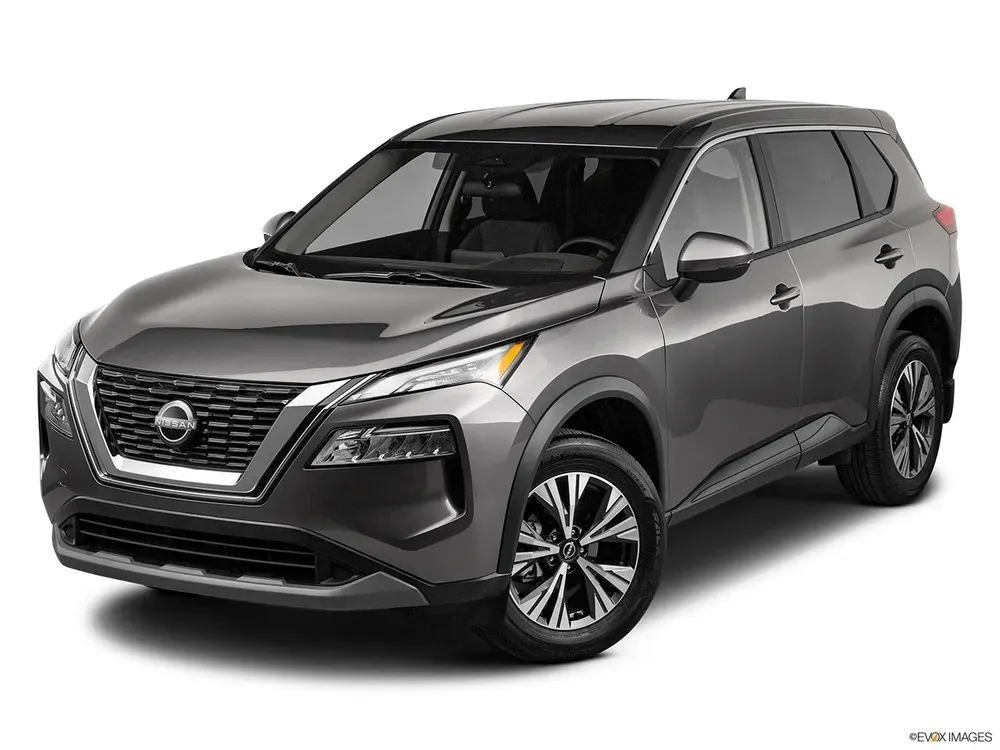
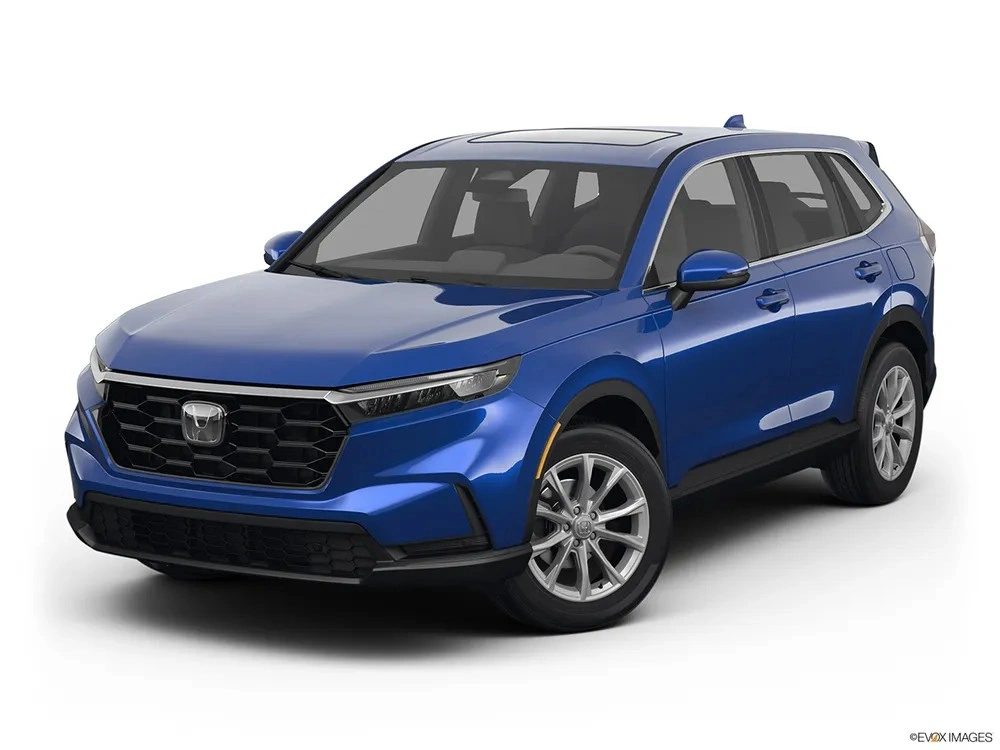
Below are selected Chinese and Japanese SUVs competing in similar segments in the UAE market.
Pricing and Equipment Strategy
In multiple SUV comparison segments, Chinese vehicles typically enter the market with:
-
Lower upfront purchase prices
-
High feature-to-price ratios
-
Advanced driver assistance systems
-
Large infotainment displays
-
Panoramic roof options
-
Extended warranty packages
Entry trims often include features that may require upgrades in competing models. For buyers focused on upfront affordability and equipment density, this approach has strengthened Chinese brand visibility in the UAE.
Learn more about how Chinese SUVs are shaping the market in our detailed analysis of Chinese SUVs winning in the UAE in 2026.
EV Growth and Market Direction
Chinese manufacturers are particularly active in the electric vehicle segment.
As EV charging infrastructure expands across Dubai, Abu Dhabi, and other emirates, electric mobility is becoming increasingly viable. Government sustainability initiatives and public charging expansion are contributing to gradual growth in EV adoption.
Affordable EV deployment is currently one of the strongest positioning advantages for Chinese brands in the region.
Depreciation and Secondary Market Trends
Resale data across the UAE used-car market indicates that Chinese vehicles generally retain around 50–60 percent of their value after three years.
Depreciation tends to be steeper in the early ownership period. While secondary market liquidity is improving, resale demand is still developing compared to longer-established competitors.
Insurance costs and parts availability may vary depending on dealership maturity and service network depth.
Long-term durability under Gulf heat conditions is still being evaluated across extended ownership cycles.
Japanese Cars in UAE: Reliability and Resale Stability
Japanese manufacturers such as Toyota, Nissan, Honda and Lexus have maintained strong market dominance in the UAE for decades.
Their positioning is built around:
-
Engine longevity
-
Proven transmission durability
-
Strong resale performance
-
Established nationwide service infrastructure
-
Predictable maintenance costs
Resale Value and Depreciation Patterns
Japanese vehicles in the UAE typically retain 70–80% of their value after 3 years. This slower depreciation curve plays a significant role in total cost of ownership calculations, particularly for medium- and long-term buyers.
Fleet demand in the UAE continues to favor Japanese brands, reinforcing secondary market liquidity and resale consistency.
Performance in Desert Conditions
Vehicles operating in the UAE face extreme temperatures and demanding driving environments.
Japanese models consistently perform well in high-heat conditions due to durable cooling systems, mechanical reliability, and long-term engine consistency. The mature service ecosystem further supports maintenance predictability and spare parts availability.
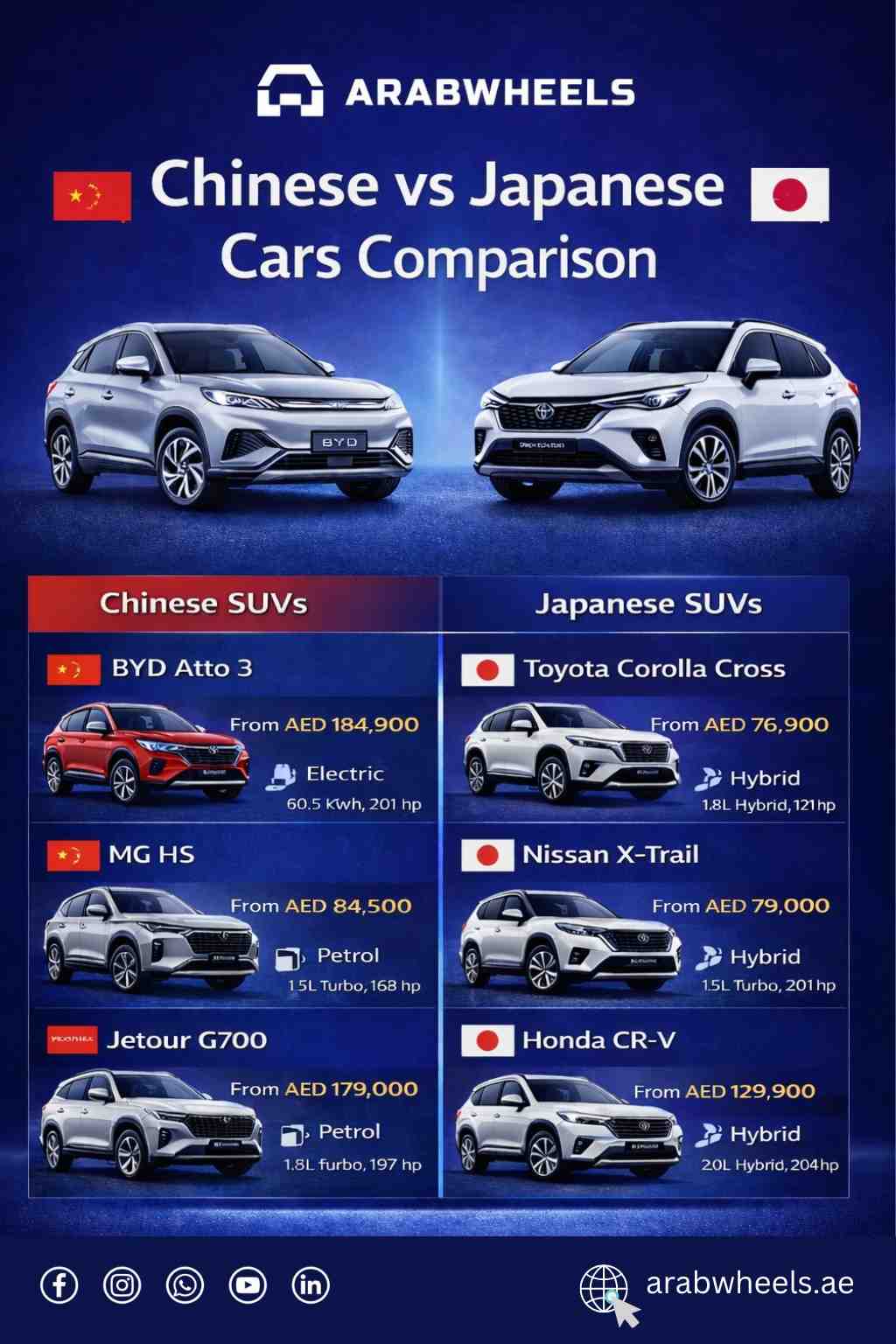
This visual highlights selected models competing in similar segments across the UAE market.
Total Cost of Car Ownership UAE: A Five-Year Perspective
The most meaningful difference between Chinese and Japanese vehicles appears when ownership is evaluated over time rather than at the point of purchase.
Ownership cost typically includes:
-
Depreciation rate
-
Maintenance predictability
-
Warranty coverage
-
Service network accessibility
-
Resale liquidity
-
Insurance variability
3-Year Value Retention Snapshot (UAE Used Market)
| Category | Chinese Vehicles | Japanese Vehicles |
|---|---|---|
| Average 3-Year Retention | 50–60 percent | 70–80 percent |
| Depreciation Curve | Steeper early decline | Gradual and stable |
| Used Market Demand | Growing | High liquidity |
| Fleet Preference | Limited adoption | Dominant |
The resale gap of approximately 15–20 percentage points can materially affect long-term ownership economics.
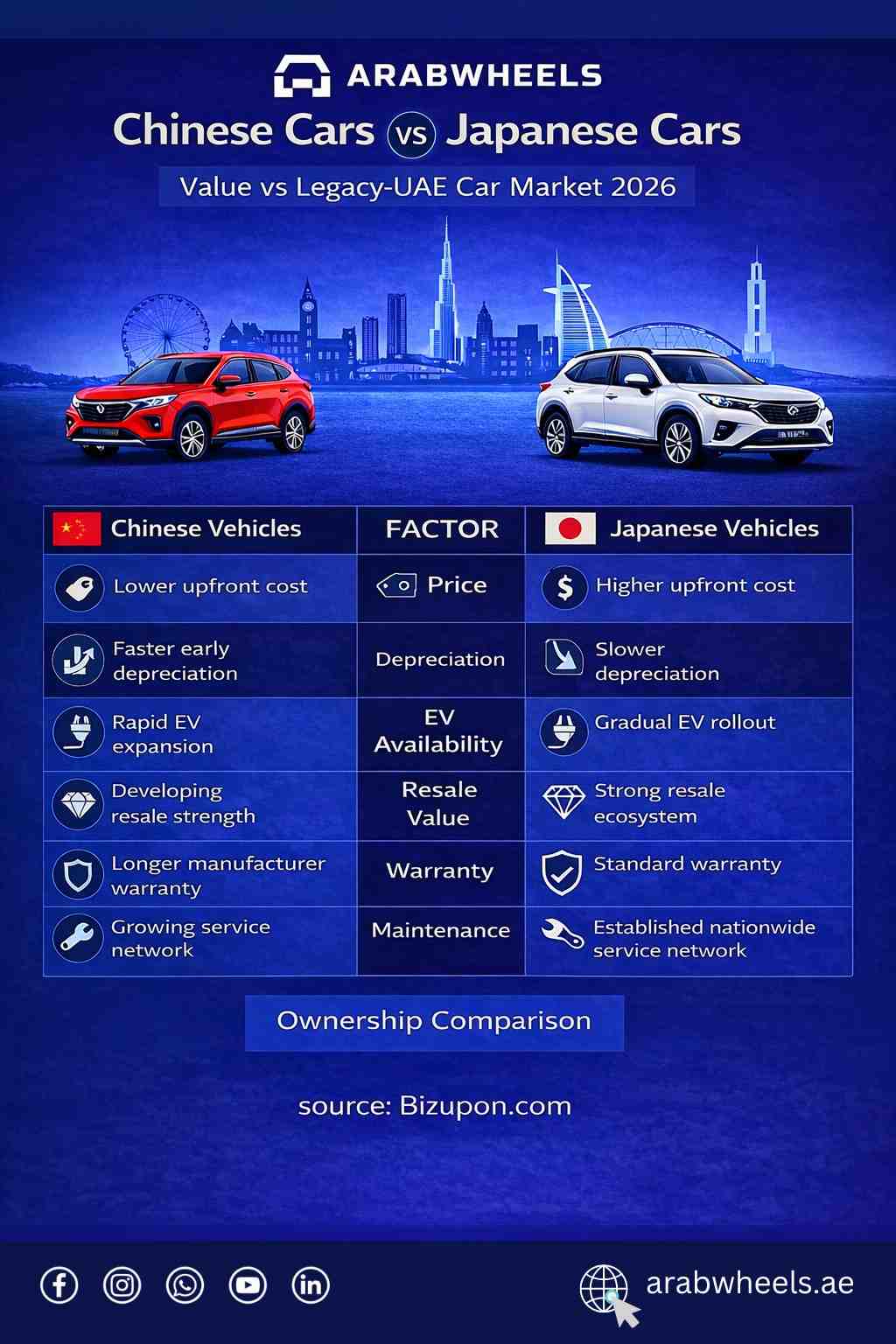
This infographic reinforces how upfront pricing, depreciation patterns, resale strength and service infrastructure influence overall ownership strategy.
EV Adoption and Industry Direction in the UAE
Electrification continues to reshape the UAE automotive landscape.
Chinese manufacturers are leading in competitively priced electric SUVs and battery-driven models, while Japanese brands are expanding hybrid and EV portfolios with a more gradual, reliability-focused rollout.
As EV charging infrastructure expands across the UAE, electric mobility is transitioning from early adoption toward broader integration.
Pro Tip for Buyers: If you’re switching cars within three years, prioritize upfront price and features. If you’re keeping it longer, focus on resale value, depreciation, and maintenance stability. The right choice depends on how long you plan to own it.
Short-Term Value vs Long-Term Stability
The real difference between Chinese vs Japanese cars in the UAE often depends on how long you plan to keep the vehicle.
For models under three years old, lower upfront pricing and stronger feature value can make Chinese models financially attractive despite faster early depreciation.
For vehicles owned for more than 5 years, Japanese vehicles typically offer stronger resale value retention, steadier depreciation, and more predictable maintenance costs.
The decision is less about origin and more about the ownership timeline.
Final Thoughts
In 2026, the Chinese vs Japanese car debate in the UAE is defined more by lifecycle cost than legacy perception.
Chinese brands emphasize pricing competitiveness, integration of digital features, and rapid EV expansion, while Japanese brands emphasize consistent resale value and a stable service infrastructure.
There is no universal winner. The decision depends on how long you plan to own the vehicle and how you prioritize upfront value versus long-term financial predictability. Both segments now play meaningful roles in diversifying the UAE automotive market.
For the latest update, insights, resale analysis, pricing updates, and ownership guides, keep following the ArabWheels Blog.
