
Why Carmakers Earn Less Profit Per Vehicle in 2026
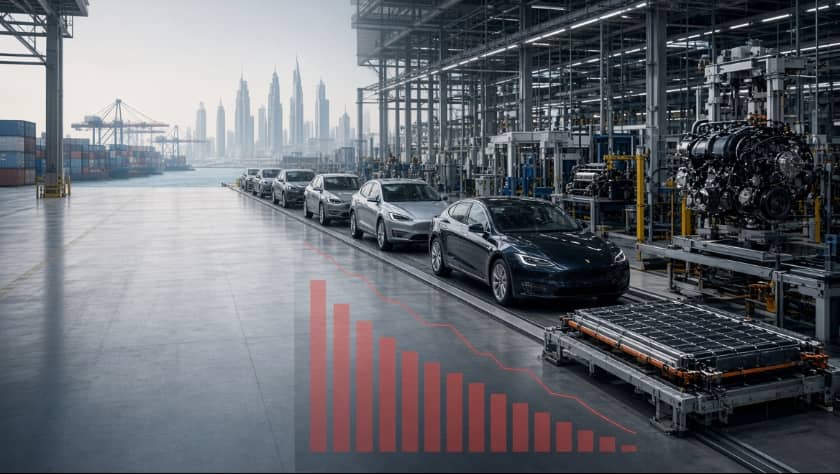
Global carmakers are still moving large volumes, but the latest industry data shows operating profitability weakening much faster than revenue. Revenue across the manufacturers studied by CAM fell only slightly, while their combined operating profit dropped much more sharply. The clearest warning sign is falling operating profit per vehicle across much of CAM’s sample.
According to the Center of Automotive Management‘s H1 2026 analysis, operating profits across its 15-manufacturer sample declined sharply. The sample covers Mercedes-Benz, BMW, GM, Toyota, Hyundai-Kia, Volkswagen Group, Tesla, Ford, Suzuki, Renault, Mazda, Mitsubishi, Nissan, Stellantis and Honda.
Average group EBIT per delivered passenger car fell from €1,409 to €1,187. That is roughly a 16% decline in average EBIT per delivered car. Combined EBIT across the 15 manufacturers fell 17.5% to €35.6 billion.
By comparison, their combined revenue fell just 1.4% over the same period. That gap suggests the problem is less about topline revenue and more about how efficiently manufacturers convert it into operating profit.
- Many legacy manufacturers are still supporting combustion and hybrid programs while investing heavily in EV platforms, batteries and software.
- Heavy discounting in China is pressuring pricing power and margins.
- New trade barriers are raising costs, and manufacturers cannot always pass the full increase on to customers.
| Metric | H1 2025 | H1 2026 Performance | Net Change (%) |
| Average EBIT Per Vehicle | €1,409 | €1,187 | -16% |
| Combined Group Operating Profits | Approx. €43.2 Billion | €35.60 Billion | -17.50% |
The Powertrain Transition Is Raising OEM Costs
Legacy automakers are navigating an expensive transition in which combustion, hybrid and electric vehicles must coexist. That means continued investment in batteries, vehicle software and EV manufacturing capacity.
For many established manufacturers, combustion and hybrid vehicles still provide an important source of earnings while they fund the transition. Demand for EVs, hybrids and combustion vehicles still varies significantly by market, making a single global powertrain strategy difficult.
That mix can add engineering and supply-chain complexity, particularly for manufacturers supporting several powertrain strategies at once. Spreading investment across multiple technologies can make it harder to reduce per-vehicle development costs.
Higher material, logistics, and incentive costs are pressuring operating margins. At the same time, intense competition limits how much of those higher costs manufacturers can recover through vehicle pricing. That helps explain why revenue can remain relatively resilient even as operating margins deteriorate.
China Price Wars and Tariffs Compress Margin per Vehicle
China remains one of the toughest markets for established international brands, with intense competition from domestic manufacturers. Chinese manufacturers including BYD have used aggressive pricing and incentives, keeping pressure on EV and plug-in-hybrid margins.
Established brands increasingly rely on incentives, price adjustments, and new products to defend sales against lower-cost competitors. Discounting reduces revenue per vehicle while much of a manufacturer’s fixed cost base remains in place.
High sales volumes offer little benefit when each vehicle sells at a thin margin. Protecting market share through heavier discounting can weaken margins and cash generation, particularly for manufacturers already carrying high fixed costs.
Tariffs are adding another layer of cost pressure. Manufacturers can raise prices to recover part of a tariff, but competitive markets make full pass-through difficult. Any tariff cost that is not recovered through pricing or other savings comes directly out of the economics of the affected vehicle.
What Squeezed Factory Margins Mean for Gulf Buyers
The question for Gulf buyers is how much of this global margin pressure eventually reaches showrooms in Dubai, Abu Dhabi and Riyadh. Gulf dealers have long used Ramadan discounts, financing offers, service packages and trade-in incentives to stimulate demand.
If manufacturers reduce incentive support as they cut costs globally, regional distributors may have less room to fund unusually aggressive promotions. One possible effect is less generous factory-backed discounting on some imported models, although that will vary by brand and inventory level.
Manufacturers may also lean more heavily on premium trims and higher-value variants where Gulf demand gives them stronger pricing power. For buyers, the practical question will be whether discounts narrow on mainstream Japanese and European crossovers as manufacturers become more disciplined on pricing.
Chinese brands are expanding rapidly across the Gulf, giving buyers more aggressively priced alternatives and putting new pressure on established value benchmarks. Established brands also have to be careful with deep new-car discounting because sustained price cuts can feed through into used-car values.
Buyers planning to sell again within two or three years should weigh the upfront saving against likely resale value.
Conclusion
For many of the manufacturers in CAM’s sample, the problem is not simply selling cars; it is earning enough from the cars they sell. Heavy investment, tariffs and price competition are changing the economics of the industry.
Volume alone offers little protection when costs rise faster than earnings per vehicle. For established manufacturers, simpler platforms, tighter cost control and less supply-chain complexity are increasingly important.
Margins are likely to remain under pressure while development costs stay high and pricing power remains weak. The manufacturers best able to control costs while maintaining pricing power should be better placed to protect profitability.
The old model of relying on mature combustion platforms for predictable margins is becoming much harder to sustain. Manufacturers that adapt their costs and product mix fastest should have more room to compete through the rest of the decade.
If margin pressure persists, weaker manufacturers could face deeper restructuring, partnerships, or consolidation. Will shrinking factory margins change how you negotiate your next car purchase in the Gulf?
Share your thoughts with us below, and follow ArabWheels Blog for our upcoming analysis on regional dealer pricing trends.