


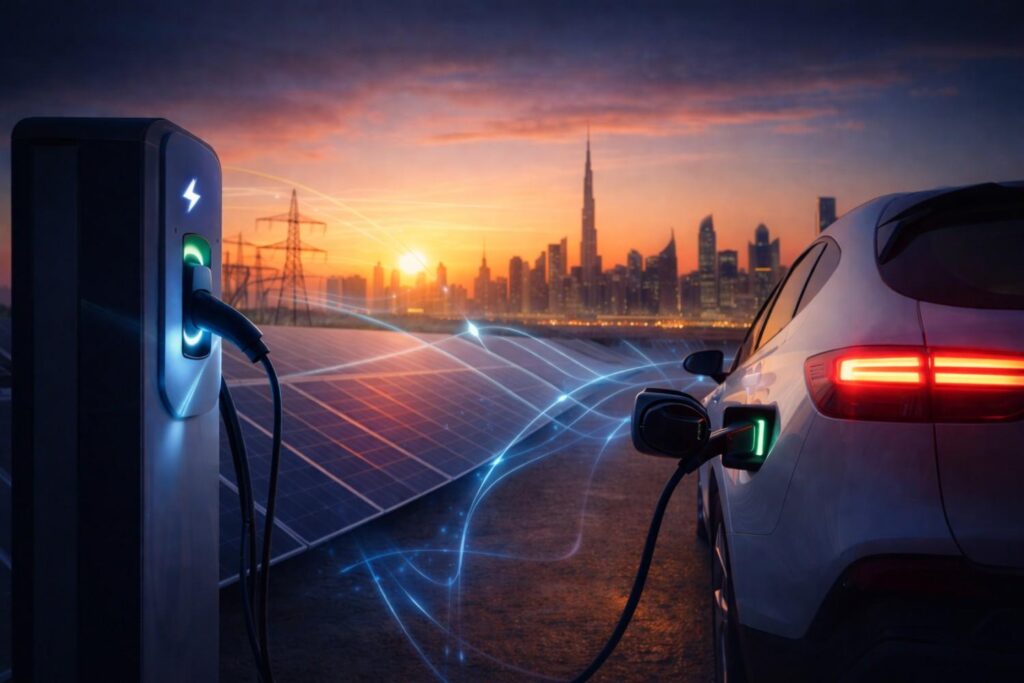
Vehicle-to-Grid in UAE 2026 is expected to mark a turning point in how electricity is managed and distributed across the country. The global energy system is already shifting away from centralized power plants toward smarter, more distributed networks. In the UAE, that transition is accelerating as renewable capacity expands and electric vehicle adoption rises.
What once sounded like a futuristic concept is steadily becoming part of practical grid planning. By 2026, EV grid integration in the UAE could begin influencing how the national power system balances solar generation, manages peak demand, and strengthens long-term energy reliability.
Key Highlights
-
Electric vehicles are evolving into grid-connected energy assets
-
UAE solar expansion increases the need for balancing solutions
-
Most EVs store between 40 and 100 kWh of energy
-
Aggregated EV fleets could rival utility-scale battery systems
-
By 2026, regulatory alignment could unlock scaled deployment
Understanding Vehicle-to-Grid (V2G)
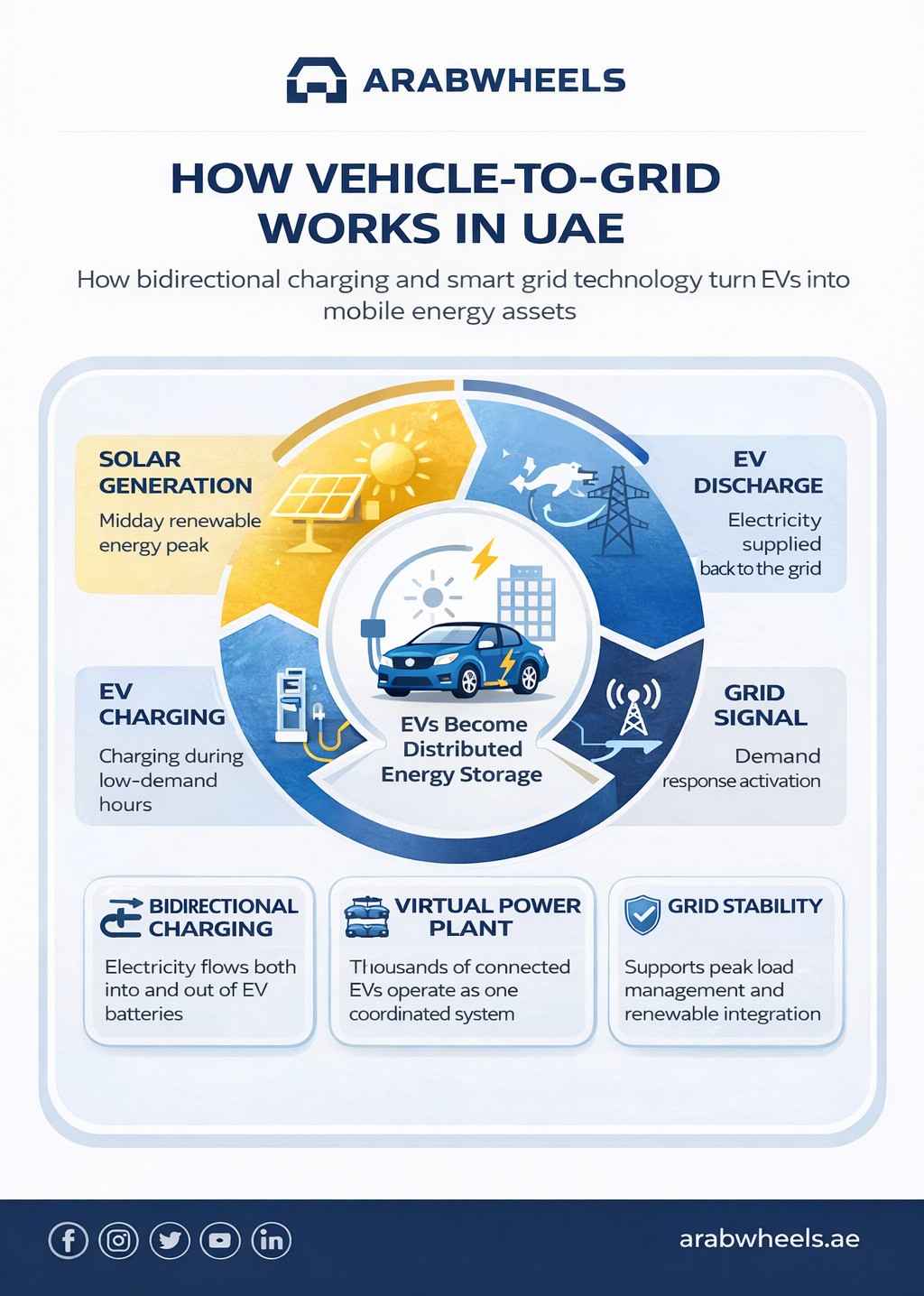
It relies on bidirectional charging technology that allows electricity to flow both into and out of an electric vehicle’s battery. Instead of functioning only as electricity consumers, EVs become part of a distributed energy storage network connected to the national grid.
Lithium-ion batteries store energy chemically during low-demand periods, often when solar generation is high or electricity prices are lower. When demand rises, aggregated vehicles can discharge stored electricity back into the grid. Grid operators send digital signals, and software platforms automatically manage responses.
At scale, thousands of connected vehicles form a virtual power plant, a coordinated system of decentralized energy resources that supports load balancing and peak demand management.
This two-way interaction transforms parked cars into flexible storage assets that enhance grid stability and overall power system flexibility.

Why 2026 Is a Strategic Turning Point
The UAE Energy Strategy 2050, led by the Ministry of Energy and Infrastructure, aims to triple renewable capacity and invest up to AED 200 billion by 2030. Dubai’s Clean Energy Strategy 2050, supported by DEWA, aims to achieve 100 percent clean energy capacity by mid-century.
Solar capacity continues to expand, particularly through the Mohammed bin Rashid Al Maktoum Solar Park. Yet solar generation peaks at midday, while electricity demand often surges in late afternoon and evening, especially during cooling seasons.
That mismatch creates grid strain.
It addresses this gap by shifting stored solar energy into peak hours.
With the rollout of charging infrastructure, corporate fleet electrification, and evolving regulations, EV adoption is expected to accelerate by 2026. Multiplied across thousands of vehicles, battery storage becomes strategically meaningful.
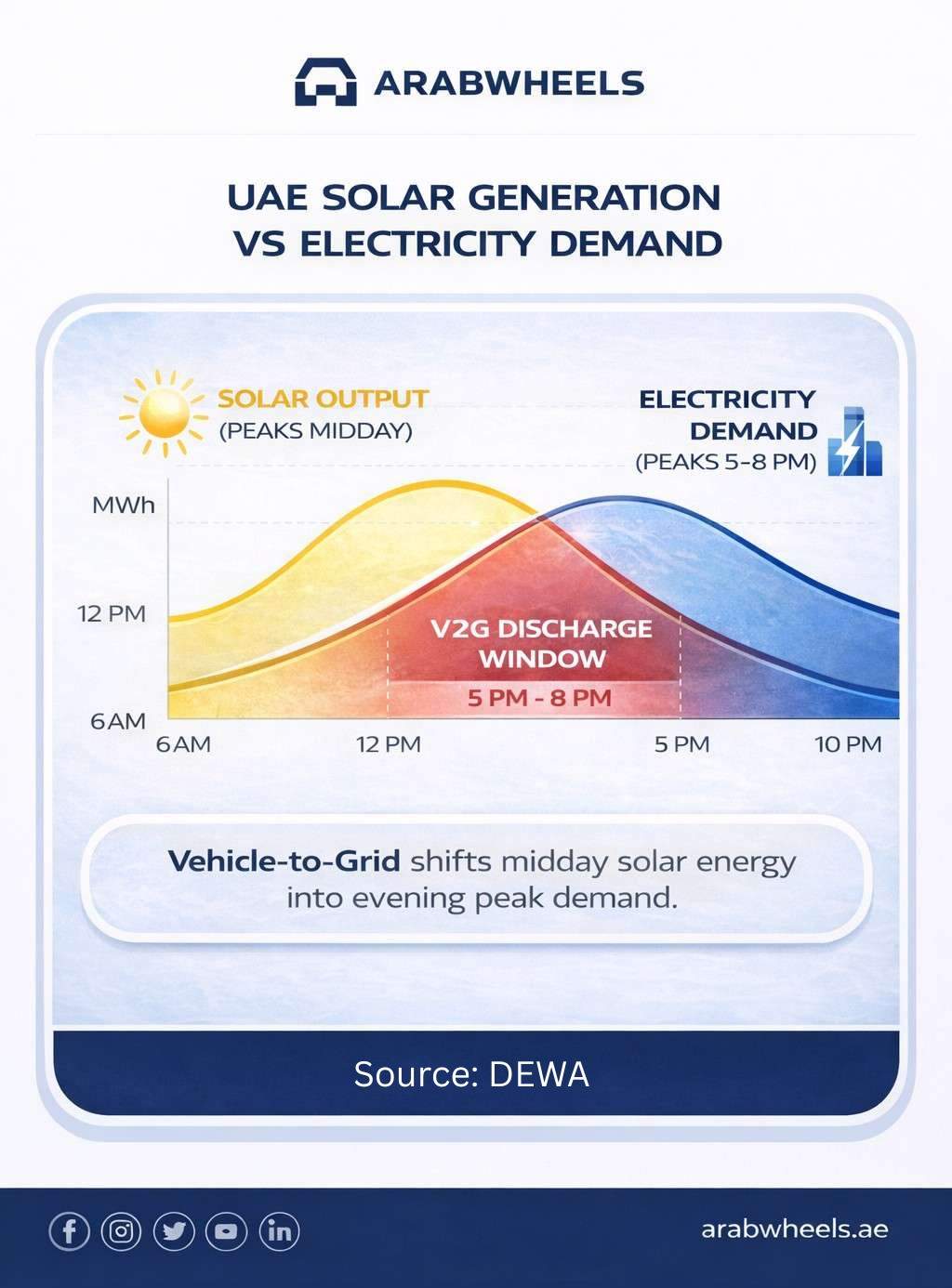

V2G fills the late-day gap when demand climbs and solar declines.
Distributed Storage Scaling Potential
To understand the impact, scale the numbers.
| Number of EVs | Avg Battery (60 kWh) | Total Storage Capacity |
|---|---|---|
| 1,000 | 60 kWh | 60 MWh |
| 10,000 | 60 kWh | 600 MWh |
| 100,000 | 60 kWh | 6,000 MWh (6 GWh) |
For comparison, many utility-scale battery projects range between 100 MWh and 500 MWh. A sufficiently large EV fleet could exceed that capacity.
When thousands of parked cars become energy assets, transport and power infrastructure converge.
Climate and Infrastructure Reality in the UAE
The UAE’s high-temperature environment requires advanced battery thermal management systems to maintain performance and longevity. Long-term participation in its programs will depend on manufacturer warranties, battery cycle durability, and regulatory clarity.
The country’s investment in smart grid, UAE initiatives and EV charging infrastructure provides a structural advantage. Integration of distributed energy storage into existing grid architecture is technically feasible, but regulatory frameworks must evolve to fully enable bidirectional power flows.
Economic Impact and Market Expansion
Vehicle-to-Grid represents more than a technical innovation. It creates a new market layer within the broader energy transition strategy of the UAE.
By participating in peak-demand events, EV owners can support demand response programs while earning compensation. Utilities benefit from enhanced grid stability in the UAE without having to build large-scale battery energy storage systems.
Globally, the V2G market was valued at approximately USD 3.1 billion in 2022 and is projected to grow at around 30 percent annually through 2030.
UAE Market Impact Overview
| Stakeholder | Strategic Benefit |
|---|---|
| Utilities | Reduced peak infrastructure costs |
| EV Owners | Potential revenue stream |
| Tech Firms | Growth in smart charging platforms |
| Government | Improved renewable integration |
How Does This Affect You as an EV Driver?
Policy meets your parking space here.
If you own an electric vehicle in the UAE by 2026, you could:
-
Earn compensation during peak demand events
-
Lower electricity bills through optimized off-peak charging
-
Contribute to national sustainability goals
-
Support grid reliability during extreme heat
Instead of being a passive electricity consumer, you become an active grid participant. Energy shifts from one-directional consumption to interactive coordination.
Key Benefits of Vehicle-to-Grid in the UAE
-
Reduces peak demand pressure
-
Enhances renewable energy integration
-
Improves grid flexibility
-
Lowers reliance on fossil fuel peaker plants
-
Supports UAE Net Zero 2050 objectives
Challenges That Must Be Addressed
Technical capability alone does not ensure adoption.
Key barriers include:
-
Regulatory updates to enable bidirectional flow
-
Transparent compensation models
-
Cybersecurity safeguards for connected vehicles
-
Consumer trust regarding battery lifespan
Cybersecurity deserves particular attention. Thousands of connected batteries form a digital energy ecosystem requiring secure communication protocols and real-time monitoring.
Without regulatory clarity and fair incentives, participation could remain limited.
Frequently Asked Questions
What is Vehicle-to-Grid in simple terms?
It allows your electric vehicle to send electricity back to the grid during peak demand using a bidirectional charger.
Is V2G available in the UAE now?
Pilot initiatives and regulatory exploration are underway. No nationwide commercial rollout has yet been fully implemented.
Will V2G damage my battery?
Modern battery management systems limit excessive cycling. Impact depends on usage frequency and manufacturer warranty terms.
Can I earn money from V2G in the UAE?
Potentially, once utilities introduce formal compensation frameworks.
The Bigger Energy Picture
By 2026, Vehicle-to-Grid in the UAE could become a structural component of the national power system, integrating renewable energy, managing peak loads, and strengthening its resilience during extreme climate conditions.
Energy is no longer simply generated and consumed. It is coordinated across decentralized energy networks using intelligent digital systems.
As the UAE advances toward its Net Zero 2050 objectives, electric vehicles may become one of the most adaptable assets within the national power system.
For the latest updates, detailed guides, and expert EV reviews, visit the ArabWheels Blog and stay ahead of the mobility transition.