
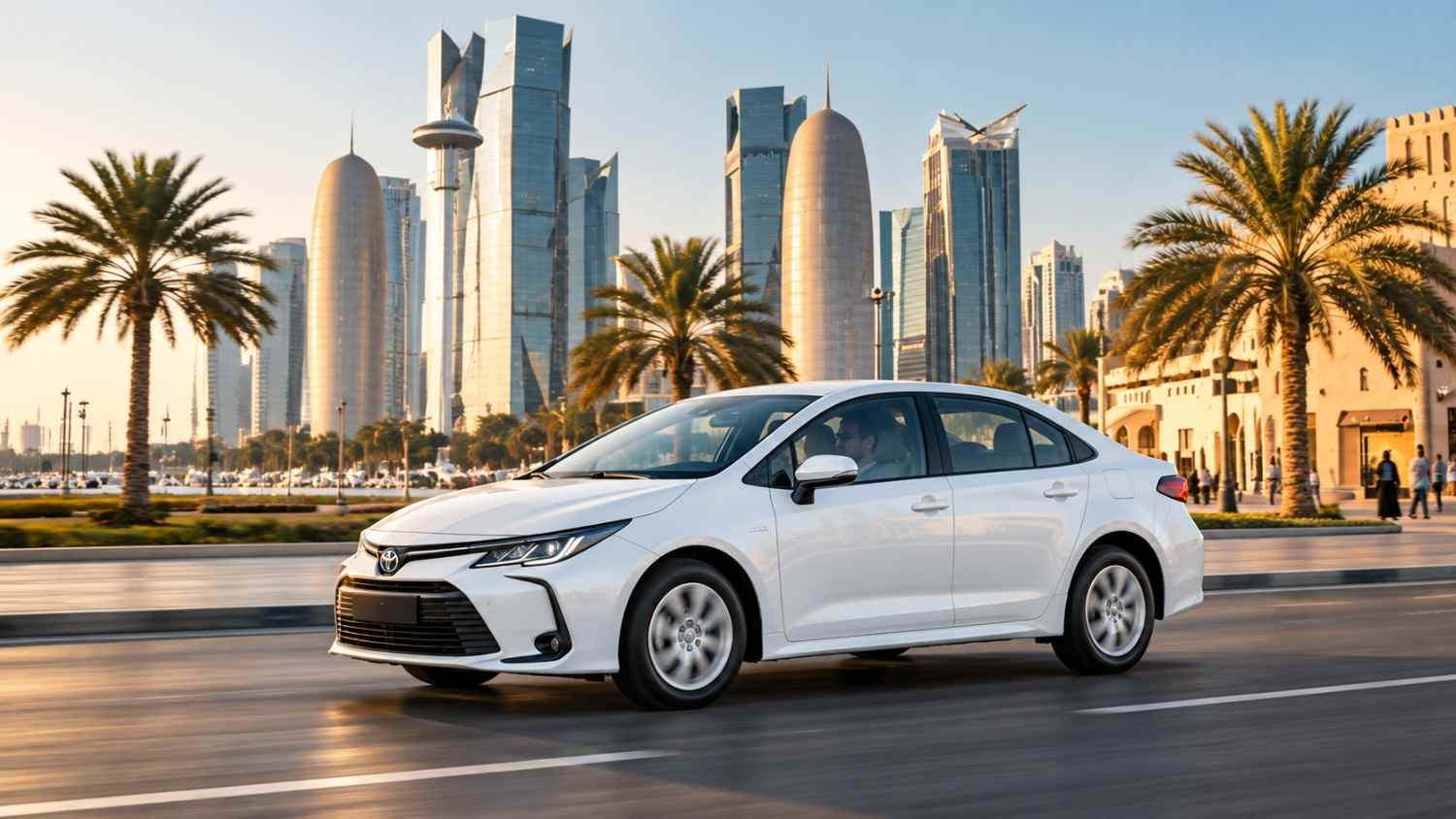
UAE Hybrid Car Trends 2026: Why PHEV Sales Jumped 450%
Why fuel economy, wider model choice and ownership costs are pushing more UAE buyers toward hybrid cars in 2026.

UAE car buyers now have far more to choose from than conventional petrol and fully electric powertrains. UAE hybrid car trends increasingly point to a middle ground, as buyers look for lower fuel consumption without making charging part of every journey.
Market data supports that shift. Statista identifies increasing demand for electric and hybrid vehicles as one of the major trends shaping the UAE passenger-car market. Its UAE automotive overview also notes that passenger-car sales exceeded 250,000 units in 2024, giving electrified models a sizeable mainstream market in which to compete.
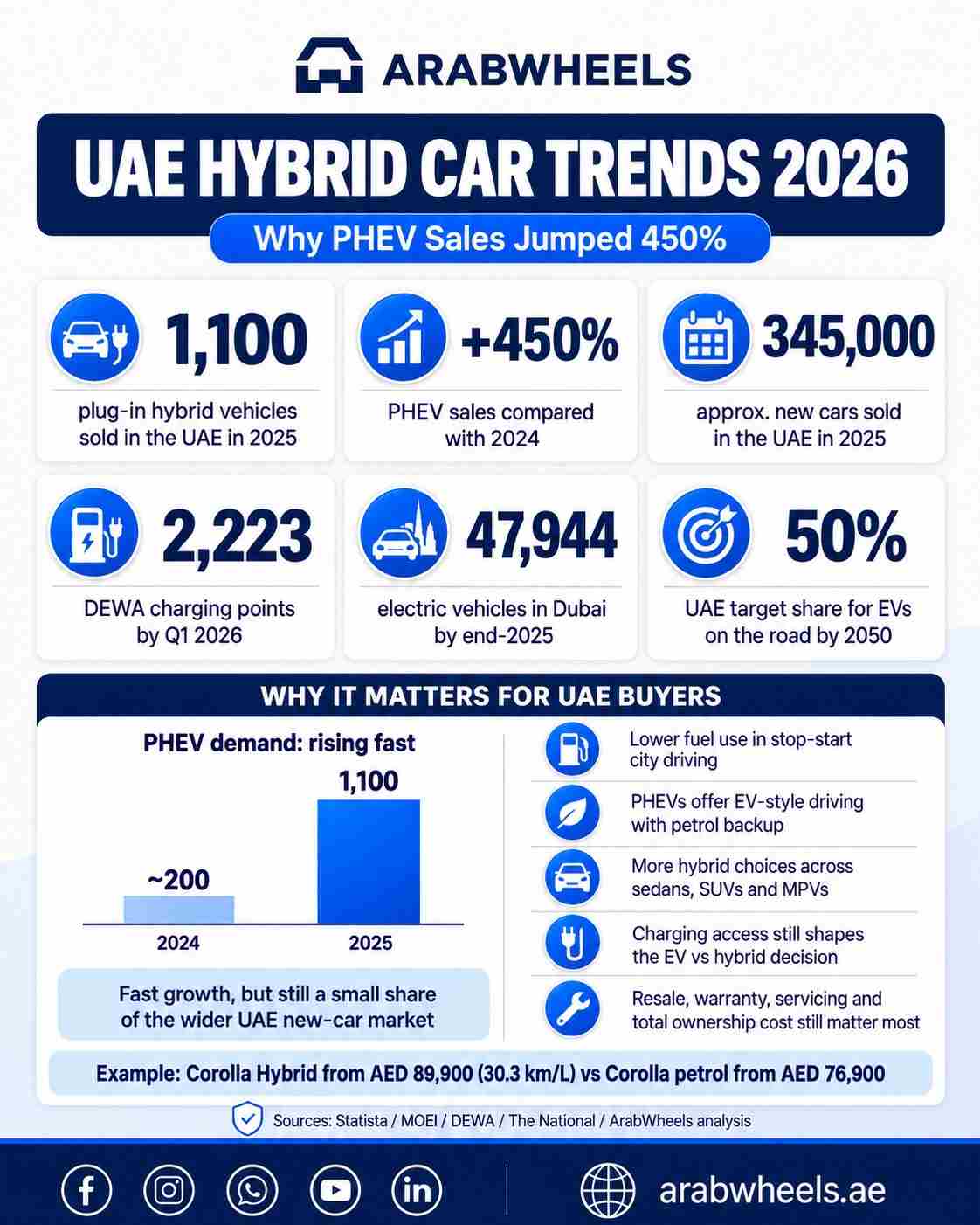
UAE sales figures for 2025 show that shift more clearly. Reported plug-in hybrid electric vehicle (PHEV) sales rose from about 200 vehicles in 2024 to 1,100 in 2025, according to industry figures reported by The National. That works out to an increase of roughly 450%.
PHEVs still accounted for a relatively small share of a market that recorded just under 345,000 new-car sales in 2025. Even so, their rapid growth shows that more UAE buyers are considering alternatives that combine petrol and electric power.
For buyers, the more useful question is what has made hybrids more relevant to UAE ownership in 2026.
UAE Hybrid Car Trends Are Moving Beyond a Niche
The UAE already has a long-term policy framework encouraging electrified transport.
The UAE’s National Electric Vehicles Policy targets a 50% share for electric vehicles on the country’s roads by 2050. The Ministry of Energy and Infrastructure has also said the policy is intended to accelerate the uptake of both electric and hybrid vehicles.
In a later official statement, the ministry described the country’s 2050 ambition as increasing the share of electric and hybrid vehicles to 50%.
Statista reaches a similar conclusion from a market perspective. Its UAE passenger-car analysis identifies fuel efficiency, environmental considerations and growing electric and hybrid demand as increasingly important market factors.
Petrol cars still dominate much of the buying landscape, but UAE shoppers increasingly have hybrid, PHEV and EV alternatives across different price points and vehicle segments.
Read more: Hybrids vs EVs UAE: Which Makes More Sense?
Fuel Economy Is Moving Higher Up the Buying List
Hybrids have an advantage in stop-start traffic because the electric motor can assist the petrol engine, while regenerative braking recovers some energy during deceleration.
The actual saving, however, depends on the vehicle, driving conditions and annual mileage.
The 2026 Toyota Corolla Hybrid provides a useful current-market example. Toyota UAE lists the Corolla Hybrid from AED 89,900 and quotes a fuel economy of 30.3 km/L. The conventional 2026 Corolla starts from AED 76,900.
That creates an AED 13,000 difference between the two starting prices.
For a high-mileage commuter, lower fuel consumption provides more opportunity to recover that initial premium. Someone driving only a few thousand kilometres each year could take considerably longer.
Fuel economy alone therefore does not determine whether the hybrid pays off. Purchase price, annual mileage and total ownership costs matter just as much.
Read more: UAE Fuel Prices and Hybrid Demand in 2026
More Hybrid Models Are Reaching Mainstream Budgets
Choice is expanding too.
Toyota’s current UAE range includes the Corolla Hybrid from AED 89,900, Corolla Cross Hybrid from AED 96,900, RAV4 Hybrid from AED 114,900, Camry Hybrid from AED 125,900 and Innova Hybrid from AED 126,900. At the upper end of the range, the Land Cruiser Hybrid starts from AED 345,900.
The range shows how far hybrid availability has expanded beyond a handful of niche models.
Hybrid technology is now available across family sedans, crossovers, MPVs, SUVs and large off-road models rather than being confined to one narrow part of the market.
A buyer considering a sedan, crossover, MPV or large SUV can therefore find hybrid options without moving to a completely different type of vehicle.
The choice is also expanding beyond conventional full hybrids. Plug-in hybrids and range-extended electric vehicles are giving UAE motorists more ways to combine electric driving with the flexibility of a petrol engine.
Charging Convenience Is Helping Hybrids Hold Their Ground
Dubai’s charging network continues to expand. DEWA said the number of charging points reached 2,223 by the first quarter of 2026.
Dubai also had 47,944 electric vehicles by the end of 2025, compared with 37,486 a year earlier — an increase of nearly 28%.
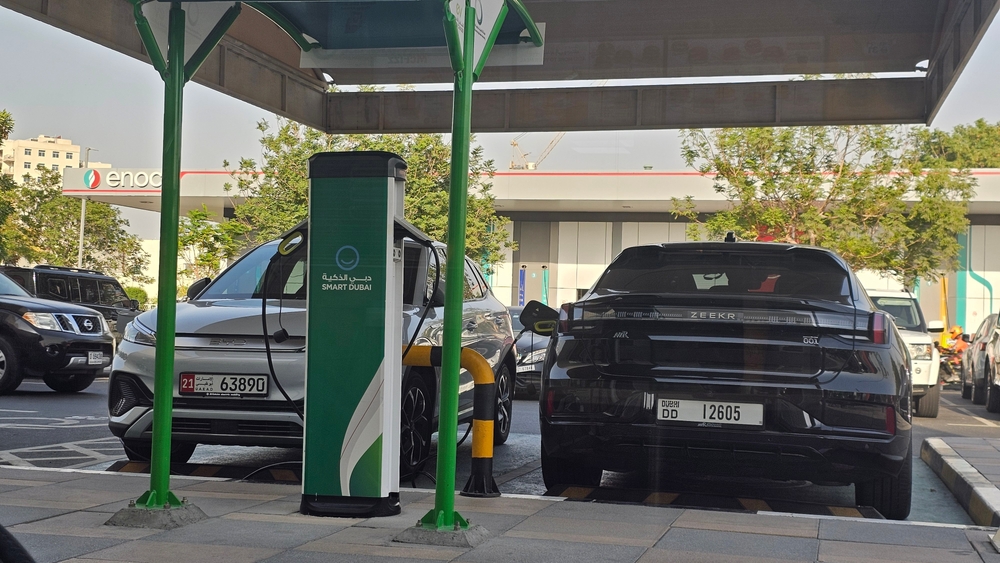
Across the UAE, Arthur D. Little’s 2026 Global Electric Mobility Readiness Index reported approximately 2,800 charging points and ranked the UAE first among GCC countries for electric-mobility readiness.
But access to charging remains an individual ownership consideration.
A villa owner who can install or use a home charger faces a different buying decision from an apartment resident who depends on public charging. Conventional hybrids avoid that issue because their batteries do not require external charging.
PHEVs and range-extended electric vehicles offer another approach. Reported UAE PHEV sales rose from about 200 vehicles in 2024 to 1,100 in 2025.
Independent automotive analyst Shijil Hashim told The National that a large portion of UAE PHEV volumes comes from range-extended electric vehicles, highlighting their appeal to buyers seeking electric driving with less dependence on charging infrastructure.
Hybrids are not a direct substitute for every EV use case. Their appeal is strongest for drivers who want some electrification without relying entirely on external charging.
Resale and Battery Confidence Still Need Checking
Fuel costs can be estimated from mileage and consumption. Resale values several years from now are much less predictable.
Buyers should avoid assuming every hybrid will retain value better simply because demand for electrified vehicles is growing.
Residual value depends on factors including the brand, model, mileage, service history, warranty coverage and the size of the used-car buyer pool.
Used-hybrid buyers should also have the traction battery and hybrid system checked rather than relying only on a conventional mechanical inspection.
Before buying, check:
- Hybrid battery warranty and remaining coverage
- Full service history
- GCC specification
- Insurance cost
- Dealer and workshop support
- Current used-car asking prices for the same model
- Expected annual mileage
A long battery warranty can provide additional confidence, but buyers should check exactly what it covers, how long the remaining coverage lasts, and whether any conditions apply.
Read more: REEV Cars UAE: Cost vs EVs and Hybrids
Final Verdict: UAE Hybrid Car Trends Point to a Bigger Role
The 2026 trend is not a wholesale move away from petrol, but a broader range of electrified alternatives competing for UAE buyers.
Reported PHEV sales increased sharply in 2025, government policy continues to encourage electrified transport, charging infrastructure is expanding, and manufacturers now offer hybrid powertrains across a wider range of vehicle types and prices.
For UAE buyers, however, the calculation remains personal.
Compare the hybrid’s purchase-price premium with your annual mileage, realistic fuel consumption, insurance, servicing, battery warranty and expected resale value. A driver covering long distances may have a much greater opportunity to recover the extra purchase cost through fuel savings than someone with a short daily commute.
The highest quoted fuel-economy figure does not automatically make a hybrid the most economical choice to own. What matters is whether the fuel savings and other ownership costs justify the initial premium over the years you plan to keep the car.
Stay ahead of UAE hybrid car trends by reading ArabWheels blogs on UAE and international automotive news, market developments, car prices and ownership insights.
