
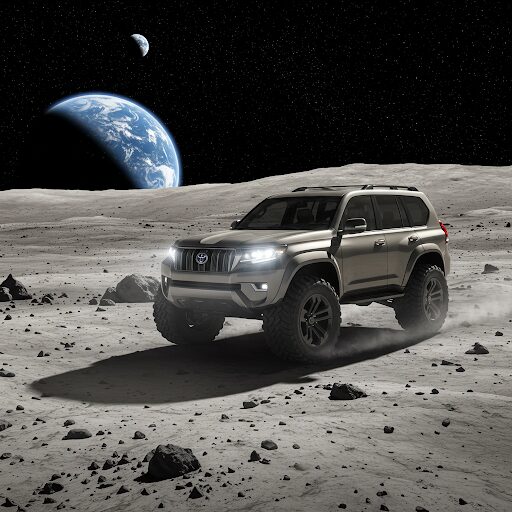
Toyota’s Lunar Cruiser: The ‘Go Anywhere’ Vehicle—On the Moon!
The automotive industry has finally reached beyond our planet with Toyota’s ambitious new venture into space exploration. The Japanese automaker’s Lunar Cruiser represents a bold leap forward in extraterrestrial transportation technology.
Inspired by its legendary Land Cruiser series, Toyota engineers have reimagined what mobility means in the challenging lunar environment. This vehicle combines Toyota’s reliability with cutting-edge space technology to create something truly extraordinary.
Scientists and astronauts have struggled with lunar transportation since the Apollo missions first deployed rudimentary rovers. The Moon’s harsh conditions demand vehicles that can withstand temperature extremes ranging from 250°F during the day to -250°F at night.
Additionally, lunar dust poses significant challenges to mechanical components with its abrasive nature and tendency to cling to surfaces. The low-gravity environment also complicates traditional automotive engineering principles that rely on Earth’s gravitational pull.
Engineering Challenges
Developing the Lunar Cruiser required Toyota to rethink vehicle design and engineering principles. The vehicle’s power system utilises next-generation fuel cell technology, generating electricity from hydrogen and oxygen. This system ensures consistent power output through extreme lunar temperature fluctuations.
Engineers employed specialised thermal management systems to protect electronics and maintain operational temperatures. Navigating the lunar surface presents unique obstacles not found on Earth. The Lunar Cruiser uses stellar navigation and inertial guidance systems without GPS satellites or magnetic poles, allowing accurate positioning in unmapped regions.
The wheels have an innovative, flexible metal mesh design that adapts to various surfaces while resisting the Moon’s corrosive effects. Communication capabilities are crucial to the Lunar Cruiser’s design, enabling constant contact with lunar bases and Earth control centres.
These systems transmit vital telemetry data and allow remote operation when needed. The onboard AI assistant processes environmental data and supports astronauts’ decision-making during their missions.
From Concept to Reality
Toyota’s Lunar Cruiser project began with partnerships with space agencies nearly seven years ago. Initial prototypes underwent rigorous testing in simulated lunar environments, revealing design flaws that engineers addressed in successive iterations.
The team prioritised reliability, knowing roadside assistance is unavailable 238,238,900 miles from Earth. The vehicle can support four astronauts for up to two weeks. Interior pressurisation allows crew members to remove helmets when necessary.
Modular attachment points accommodate scientific equipment based on mission needs, transforming the Cruiser from transport to a mobile research platform. Material selection was crucial as traditional automotive materials would fail under lunar conditions.
Advanced carbon composites and alloys provide excellent strength-to-weight ratios and environmental resistance, and they have been tested over the years in simulations. The Lunar Cruiser signals a new era in lunar exploration and colonisation.
Conclusion
Toyota’s Lunar Cruiser is more than a technological achievement; it represents humanity’s determination to explore beyond our planet. As lunar missions increase, reliable transportation will be vital. The Cruiser is ready to fulfil this role and set new extraterrestrial vehicle design and performance standards.
Each journey will enhance our understanding of the Moon and our place in the cosmos. Thanks for reading till the end. Let us know what you think in the comments below. Keep following the Arabwheels Blog for more content like this.