
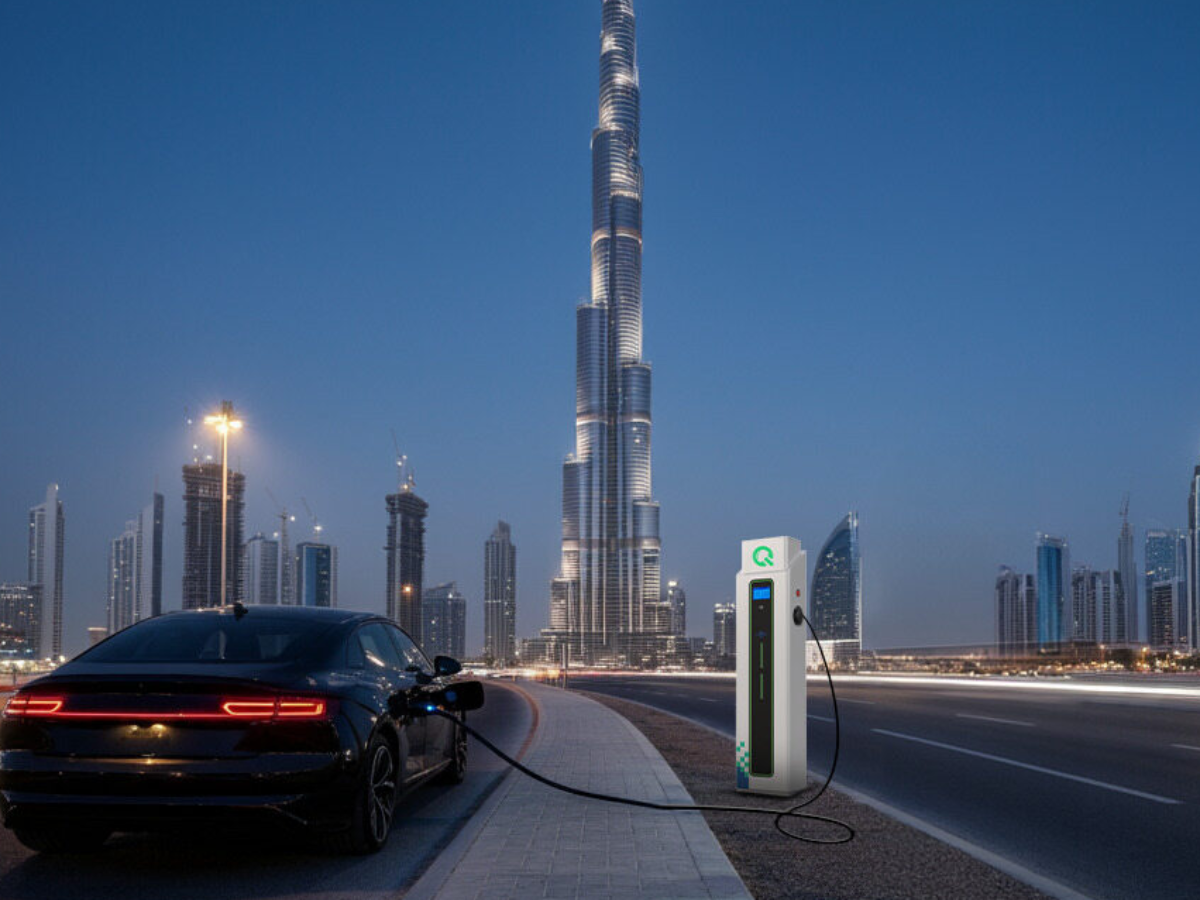
Top EV / Green Mobility Trends You’ll See in UAE in 2026
How the UAE’s push for electric vehicles is reshaping mobility, infrastructure, and business opportunities by 2026.

The future of driving in the UAE is getting electric, literally. By 2026, the country’s journey toward EV electric vehicles and green mobility trends will accelerate, powered by bold government policies, an expanding network of charging stations, and a surge of innovation shaping everyday transport.
Over the past few years, the UAE has built a strong foundation for electric cars through incentives, infrastructure upgrades, and public awareness campaigns. Now comes the exciting part, the phase where scale meets experience. From daily commutes to fleet operations, nearly every aspect of urban mobility is evolving toward a brighter, cleaner, and more connected future.
Quick Summary
By 2026, the UAE will witness a rapid shift toward EVs and green mobility, driven by strong government policies, clean-energy investments, and expanded charging networks. Expect more ultra-fast EV chargers, electric taxi fleets, hydrogen transport, and innovative mobility apps transforming how people move.
For drivers and businesses, this evolution means lower running costs, eco-friendly commutes, and new opportunities in the sustainable transport market. In short, electric vehicles in the UAE are transitioning from a trend to a mainstream reality, paving the way for a brighter, cleaner, and more connected future by 2026.
Why do electric vehicles matter in the 2026 context in the UAE?
The driving force behind electric vehicles in the UAE is clear; the country is aligning with the UAE Net Zero by 2050 Strategy and local commitments, such as the Dubai Green Mobility Strategy 2030.
Key drivers include:
-
Targeted regulation: 30 % of public-sector vehicles to be electric/hybrid in Dubai by 2030.
-
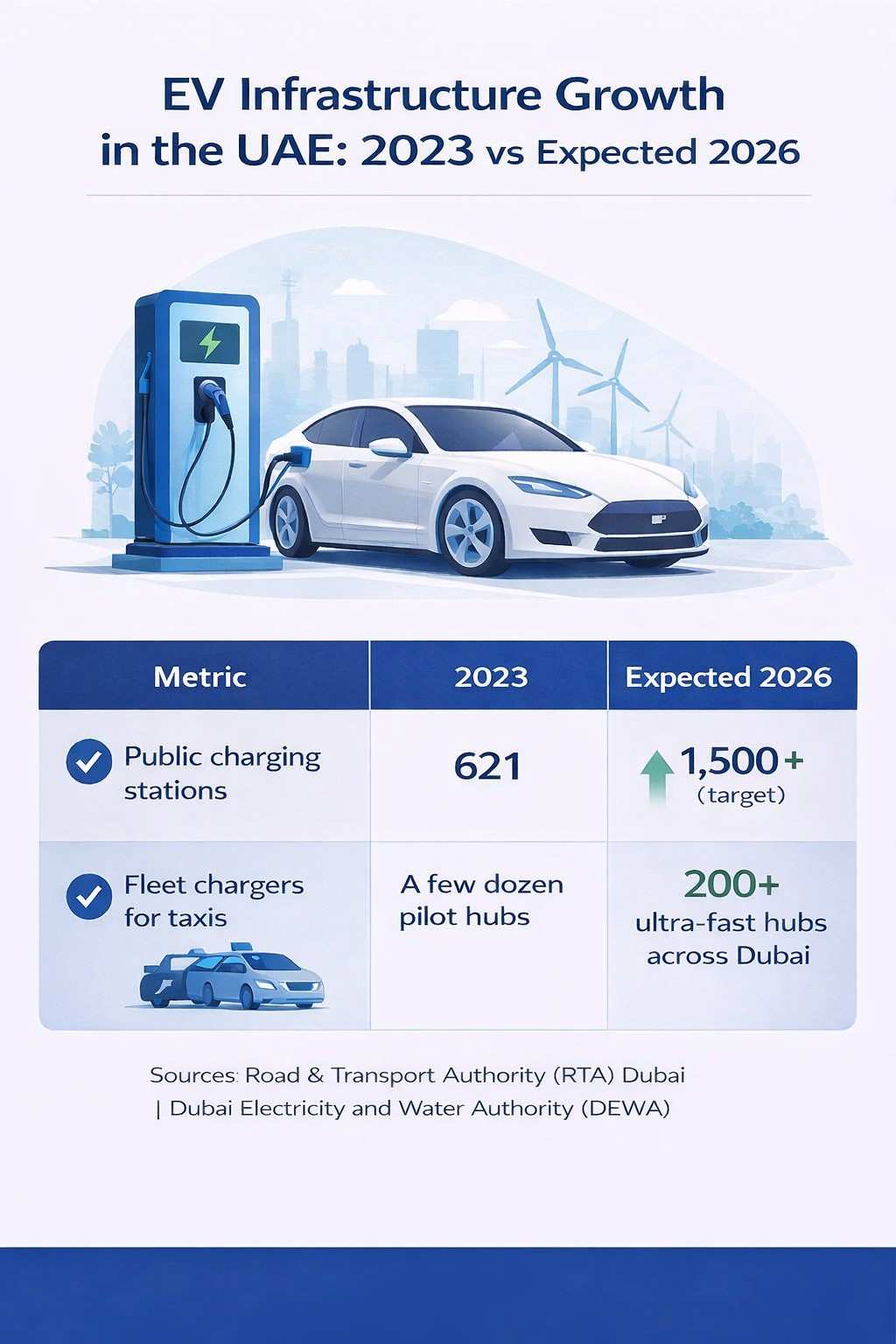
Infrastructure expansion: More than 620 public charging stations in the UAE already, planning for tens of thousands more.
-
Market growth: CAGR of 30 % in the EV market forecast between 2022 and 28.
-
Incentives: Free parking, free SALIK tags, and priority access for EV owners via the Road & Transport Authority (RTA) in Dubai.
For you, as a consumer or business, this means lower operating costs, tax/fee advantages, and rising resale values for EVs.
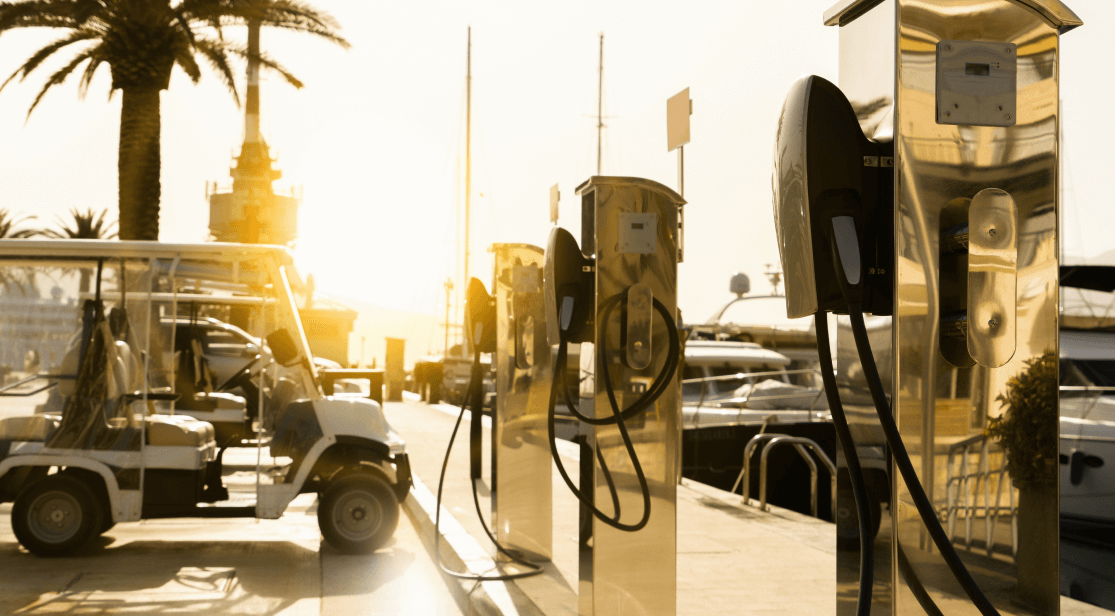
Five Green Mobility Trends to Watch in 2026
1. Charging Infrastructure Growth & Ultra-Fast Rollout
The UAE’s EV transformation begins with one essential piece of charging infrastructure. Over the next few years, charging stations will become as common as petrol pumps, with ultra-fast hubs lighting up highways and city centers. Dubai alone is installing over 200 high-speed charging stations dedicated to taxis.
-
Ultra-fast DC chargers are being deployed at highways and taxi hubs; Dubai is already rolling out over 200 ultra-fast chargers for taxis.
-
Building code mandates, e.g., new Dubai buildings must allocate 5 % of parking spaces for green / low-emission vehicles.
-
Inter-emirate corridors and a regional charging network linking the UAE to the GCC borders.
Infrastructure growth snapshot
When buying an EV in the UAE, consider checking local charging access and charging speeds (50 kW vs 150 kW+).
2. Electrification of Fleets and Shared Mobility
Beyond private cars, the real momentum in green transport comes from shared and commercial fleets. Ride-hailing companies, delivery operators, and even government fleets are switching to electric power, reshaping how people and goods move every day.
-
Ride-hailing, car-sharing, and taxi fleets converting to EVs; hire vehicles will increasingly be electric vehicles in the UAE.
-
Government fleets in the public sector are expected to convert to electric/hybrid by 2030.
-
Micro-mobility (e-scooters, e-bikes) integrated with mass transit.
-
For businesses and operators: opportunities in fleet electrification, battery leasing, and fleet-management services.
3. Alternative Fuels and Hydrogen Integration
While EVs lead the charge, hydrogen and alternative fuels are quietly building a strong presence. The UAE’s energy giants see hydrogen as a key player in decarbonizing heavy transport from buses to long-haul trucks.
-
The Abu Dhabi National Oil Company (ADNOC) and related companies are building hydrogen refuelling stations.
-
Development of “green hydrogen” for mobility, not just power generation.
-
Electric vehicles in the UAE will integrate with hydrogen/hybrid infrastructures, especially for buses, trucks, and commercial fleets.
4. Smart Mobility, Connectivity, and Autonomous Systems
In the UAE’s vision of green mobility, vehicles aren’t just electric, they’re smart, connected, and self-driving. With the RTA’s self-driving initiatives and rapid tech adoption, Dubai is on track to make AI-powered mobility a daily reality.
-
Intelligent charging, vehicle-to-grid (V2G) systems, connected car analytics.
-
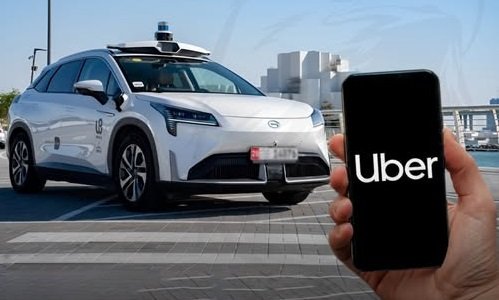
Autonomous electric taxi programs under the RTA’s self-driving strategy.
-
Apps integrating EV charge-planning, shared rides, and micro-mobility options for seamless movement.
5. Secondary Market, Battery Recycling & Lifecycle Services
As the number of electric cars on UAE roads keeps climbing, the ecosystem around them is also evolving. A new focus is emerging on what happens after the first charge. From recycling batteries to creating certified used-EV markets, the UAE is building the backbone of a truly circular mobility system.
-
Battery recycling for second-life use in stationary energy storage units.
-
Insurance and servicing models are adapting to the EV era. (Today, EV insurance in the UAE can be up to 72 % higher than petrol vehicles, but new risk models are changing that.)
-
Resale value improvement through certified used-EV programmes and extended battery warranties.
Tip: When choosing an EV, always check the battery warranty terms, charging port compatibility, and the total long-term ownership cost.
What This Means for Me (the Reader)
If you live, commute, or invest in the UAE today, then in 2026:
-
Your next car purchase decision will likely include an electric car option with a stronger value proposition (lower fuel cost, fewer moving parts, government incentives).
-
Infrastructure will be better, charging will be faster, there will be more locations, and the user experience will be smoother.
-
Businesses operating logistics, fleets, or delivery services can benefit from lower total cost of ownership and regulatory tailwinds.
-
The shift means planning: check charger access near home/work, monitor electricity tariffs, pay attention to battery health, and consider a resale strategy.
-
With shared mobility and innovative services, you might spend less time driving and more time on productive or leisure activities, and mobility becomes part of your lifestyle.
Quick Tips Checklist
-
Always choose an EV model with a charger network backed by a provider registered with the RTA.
-
If installing a home charger, check building regulations and parking-space allocations for “green” vehicle charging.
-
Monitor changes to government incentives, such as free SALIK stickers or preferred parking for plug-in vehicles.
-
For businesses, consider leasing battery packs or adopting “mobility as a service” models to reduce upfront investment.
-
Plan for battery end-of-life early and check if the manufacturer offers recycling or repurposing programs.
Frequently Asked Questions(FAQs)
Q1: What qualifies as an “electric vehicle UAE”?
It refers to Battery-Electric Vehicles (BEVs) or plug-in hybrids (PHEVs) registered in the UAE market under the national EV policy.
Q2: Are incentives available for EV buyers in the UAE?
Yes, examples include free parking, free SALIK tag, reserved parking, and priority charging locations in Dubai.
Q3: Will the charging network cover the whole UAE by 2026?
While full coverage may not be guaranteed, targets and ramp-up plans show strong growth. For example, more than 70,000 charging points are planned in Abu Dhabi by 2030.
Q4: What are the disadvantages of electric vehicles in the UAE?
Higher insurance costs and battery degradation remain concerns; research shows EV insurance can be 72% higher than petrol car insurance in the UAE.
Final Thoughts
Adopting EV and green Mobility trends in the UAE by 2026 means being part of a transformative shift in mobility. It’s not just about replacing petrol cars; it’s about embracing cleaner energy, smarter transport, and reimagined cities. Whether you are buying your next vehicle, running a fleet, or planning mobility infrastructure, the trends are clear.
Ready to Drive Into the Future? Explore in-depth insights, the latest EV models, government incentives, and charging-location updates, all in one place. Read more on the ArabWheels Blog and stay ahead in the UAE’s green-mobility revolution.
