


Sodium Ion vs LFP Batteries: Which Makes Sense in 2026?
Why sodium-ion is rising as LFP still leads the EV battery market

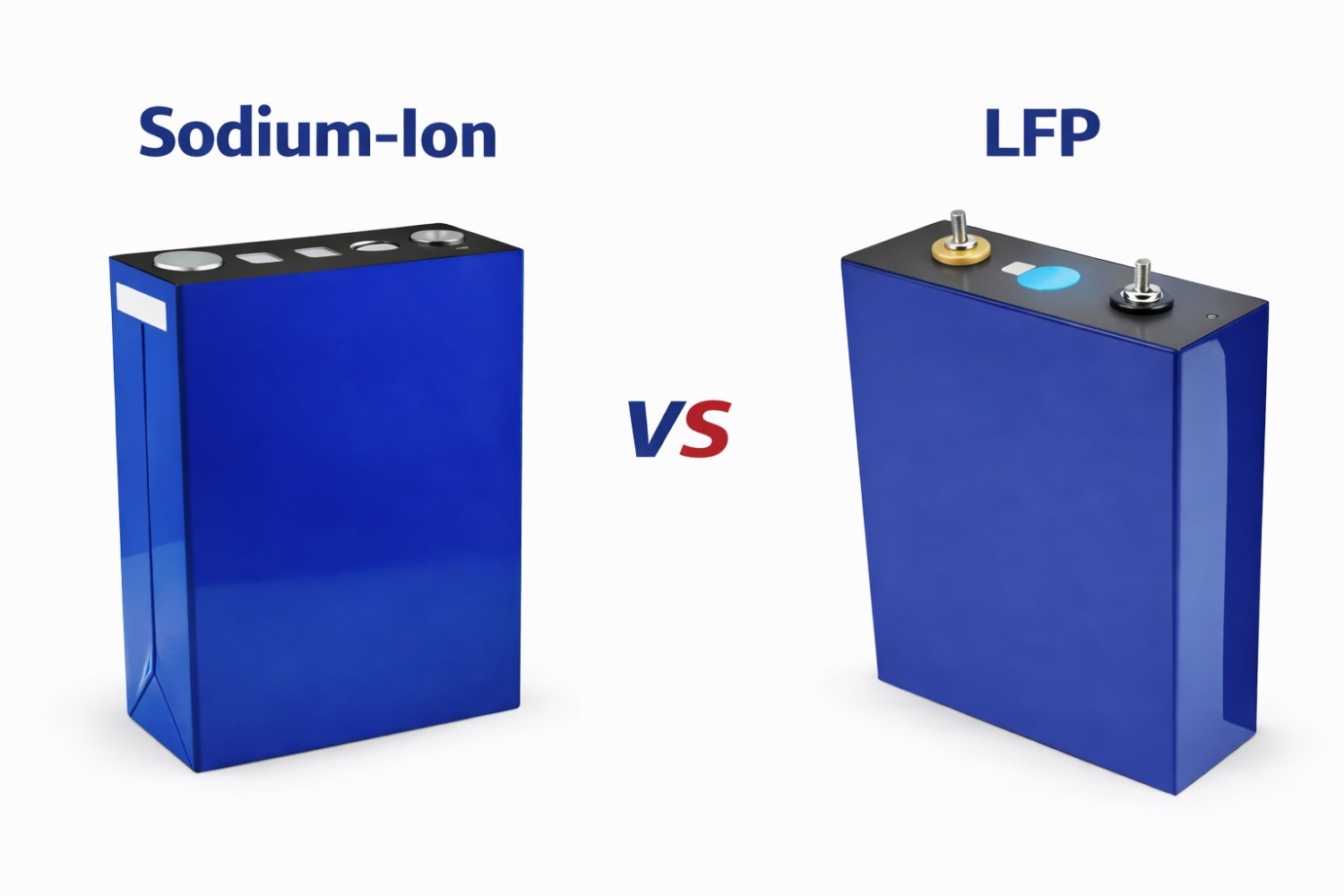
Sodium Ion vs LFP Batteries is no longer a niche lab argument. In 2026, it sits at the centre of the EV cost debate as carmakers chase safer packs, steadier supply chains, and lower sticker prices. Electric car sales topped 17 million globally in 2024, and LFP accounted for nearly half of the EV battery market, so any serious rival now matters.
Lithium iron phosphate batteries already power a huge share of today’s electric cars. Sodium-ion, meanwhile, has moved beyond lab demos and into early commercial vehicles and storage systems. That shift matters for EV buyers in the UAE, fleet operators, and anyone trying to understand where battery costs and performance go next. CATL launched its first-generation sodium-ion battery in 2021 and says its newer Naxtra sodium-ion battery entered mass-production applications in 2026.
Key Highlights
-
LFP remains the safe, bankable choice for mainstream EVs in 2026.
-
Sodium-ion batteries are gaining ground because they can reduce dependence on lithium and lower production costs. The IEA says sodium-ion production costs can be about 30% lower than LFP.
-
CATL says its Naxtra sodium-ion EV battery achieves 175 Wh/kg, putting it in the same conversation as some LFP packs.
-
BYD’s Blade Battery keeps LFP highly relevant with official claims of more than 5,000 charge cycles and strong safety performance.
-
For UAE buyers, the key issues are price, thermal stability, charging access, and long-term support.
Understanding the Two Battery Technologies
What are LFP batteries?
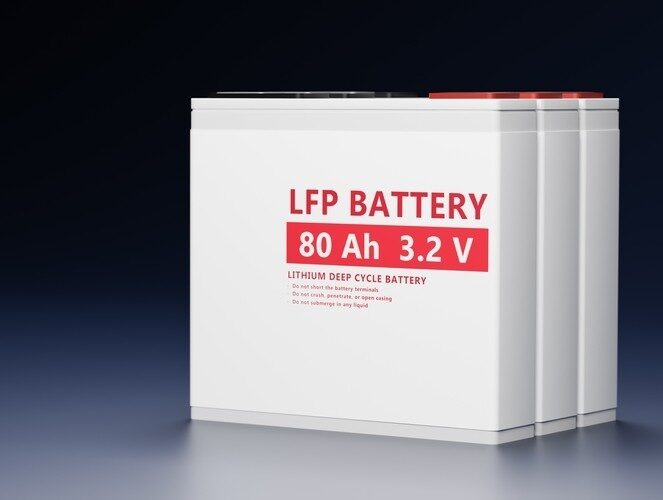
LFP stands for lithium iron phosphate. It is a lithium-ion chemistry built around iron and phosphate rather than nickel and cobalt. That matters because it improves thermal stability, cuts reliance on scarcer materials, and has helped make lower-cost EVs viable at scale. BYD says its Blade Battery, which uses LFP chemistry, exceeds 5,000 charge and discharge cycles and is designed around safety and durability.
LFP’s big advantage is maturity. It is already deployed at scale, has a proven manufacturing base, and is well understood by automakers, regulators, and service networks. The IEA says LFP accounted for nearly half of the global EV battery market in 2024, underscoring just how entrenched it has become.
What are sodium-ion batteries?
Sodium-ion batteries work on similar principles to lithium-ion batteries, but they use sodium instead of lithium as the main charge carrier. Sodium is abundant, widely distributed, and attractive to companies seeking to reduce mineral risk and lower battery costs. The IEA says sodium-ion batteries are emerging as a new player that can diversify battery chemistries and supply chains.
The catch is that sodium-ion is still early. Commercial momentum is rising, but the chemistry does not yet have the same real-world track record as LFP across millions of passenger EVs. That makes 2026 a transition year rather than a full takeover year.

Sodium Ion vs LFP Batteries: The Key Technical Trade-Off
| Feature | Sodium-ion batteries | LFP batteries |
|---|---|---|
| Market maturity | Early commercial stage | Mass-market and widely deployed |
| Materials | Uses abundant sodium, avoids lithium in the cell chemistry | Uses lithium, but avoids nickel and cobalt in most LFP designs |
| Energy density | CATL says Naxtra reaches 175 Wh/kg | Generally stronger today in proven mass-market EV use; CATL says Naxtra is now comparable to LFP |
| Cycle life | Improving fast; CATL says Naxtra can exceed 10,000 cycles | Proven long life; BYD says Blade exceeds 5,000 cycles |
| Temperature behavior | Strong low-temperature performance is a major selling point | Strong thermal stability and safety, especially in high-heat conditions |
| Best near-term fit | Entry EVs, cold-weather use cases, and stationary storage | Mainstream EVs, fleets, high-confidence mass deployment |
Table based on official supplier claims and IEA market analysis. Real-world performance varies by pack design, vehicle integration, and charging strategy.
The short version is simple. LFP wins on maturity, scale, and bankability. Sodium-ion wins on material abundance and cost potential. The IEA expects sodium-ion to remain below 10% of EV batteries through 2030, while growing more visibly in stationary storage, where cost matters more than maximum energy density.
Why Automakers Are Taking Sodium-Ion Seriously
The first reason is cost. Batteries remain one of the most expensive parts of an EV, and the IEA says sodium-ion batteries can be materially cheaper to produce than LFP because they use less expensive materials and avoid lithium.
The second reason is supply-chain diversification. Carmakers do not want all their future growth tied to one mineral system. Sodium-ion offers a hedge against lithium volatility, which is why it keeps turning up in strategy discussions even before it reaches large-scale passenger EV adoption.
The third reason is use-case flexibility. Sodium-ion looks especially promising for stationary storage and some lower-cost vehicles. For a wider look at where chemistries are heading, see our Future Battery Technologies Overview.
Why This Matters in the UAE
For UAE buyers, this is not abstract battery jargon dressed up in a lab coat. Climate, charging access, and resale confidence all matter. Dubai’s DEWA says its EV Green Charger network has expanded to more than 400 charging stations, capable of serving around 740 electric vehicles at once. That makes the ownership picture better than it was a few years ago, but battery chemistry still shapes cost, range, and peace of mind.
Here is the practical takeaway:
-
If you want a proven EV battery today, LFP is still the stronger bet.
-
If you are watching lower-cost city EVs or future storage systems, sodium-ion deserves attention.
-
If you drive in hot weather and want broad service familiarity, mature LFP platforms still have the edge.
For more local context, read our EV Charging Infrastructure Guide. And if you are weighing ownership costs, charging, and everyday usability, our Electric Vehicle Buying Guide 2026 is the logical next stop.
Market Momentum in 2026
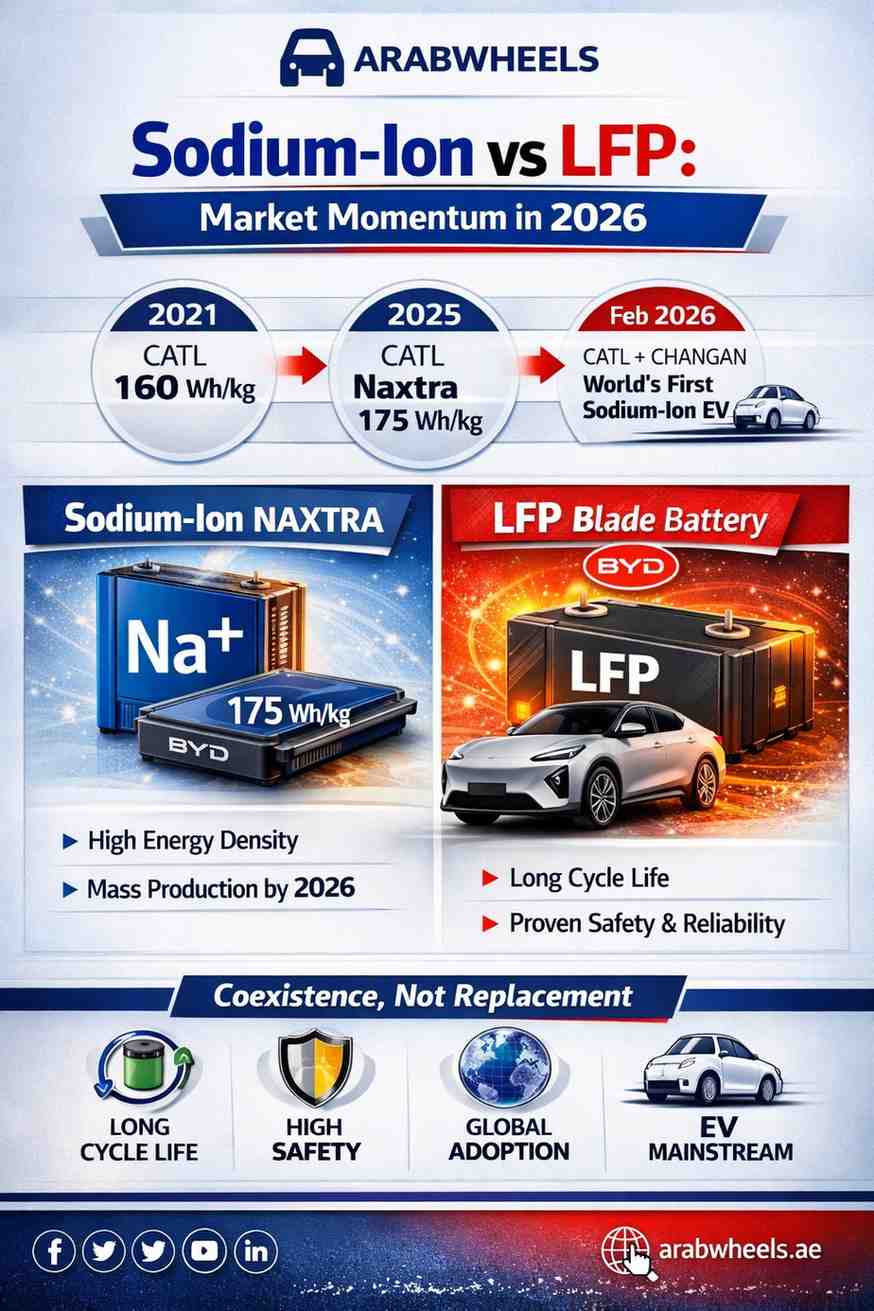
CATL’s sodium-ion story has moved quickly. The company’s first-generation sodium-ion battery reached 160 Wh/kg in 2021. Four years later, CATL introduced Naxtra and claimed 175 Wh/kg for its passenger EV battery. In February 2026, CATL and Changan then announced what was described as the world’s first mass-produced sodium-ion passenger vehicle project.
LFP, though, is not standing still.BYD’s Blade Battery remains one of the clearest examples of why LFP still dominates mainstream deployment: long cycle life, strong safety claims, and a chemistry already trusted across large EV lineups. That is why the real 2026 story is not a replacement. It is coexistence.
Frequently Asked Questions (FAQs)
Are sodium-ion batteries better than LFP batteries?
Not across the board. In 2026, LFP remains the better-established choice for mainstream EVs, while sodium-ion is the more promising challenger for lower-cost applications and energy storage.
Which battery is cheaper?
The IEA says sodium-ion production costs can be around 30% lower than LFP, which is a major reason the chemistry is getting attention. That does not automatically mean every sodium-ion EV will be cheaper today, but the cost logic is real.
Is sodium-ion already in real vehicles?
Yes. CATL says its Naxtra sodium-ion battery has entered mass production for passenger vehicles in 2026.
Will sodium-ion replace LFP soon?
Probably not. The IEA expects sodium-ion batteries to remain below 10% of the EV battery market through 2030, suggesting a supporting role rather than a near-term takeover.
Conclusion
In 2026, LFP still makes more sense for most EV buyers because it is proven, widely deployed, and backed by a mature supply chain. Sodium-ion is the chemistry to watch because it could lower costs, diversify battery sourcing, and open new paths for entry EVs and storage. For ArabWheels readers, that is the real answer to Sodium Ion vs LFP Batteries.
