
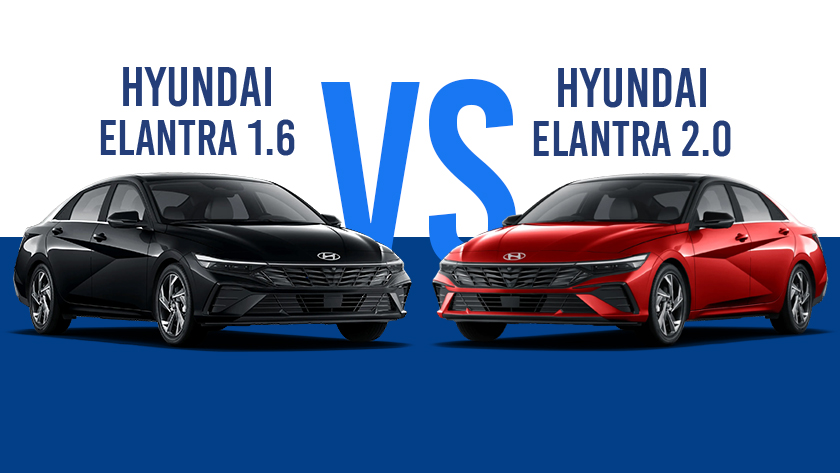
Hyundai Elantra 1.6 vs 2.0: Performance and Mileage Comparison
Hyundai Elantra 1.6 vs 2.0: Key Differences Explain

The Hyundai Elantra has always been a favorite among compact sedan buyers for its sleek design, fuel efficiency, and everyday practicality. But suppose you’re planning to buy one. In that case, you’ve probably noticed two popular engine options, the Hyundai Elantra 1.6 Vs .2.0. While both look identical from the outside, they’re pretty different under the hood. So, which one should you choose? Let’s compare their performance and mileage, exploring power, efficiency, comfort, and value for money.
But before that, let’s take a quick look at its journey and how it became one of the most refined sedans in its class.
Hyundai’s Journey Toward Innovation
It started in 1967 in South Korea and quickly grew into one of the world’s most trusted automotive brands. Known for reliability, technology, and affordability, it has consistently blended innovation with everyday comfort. The company invests heavily in electric mobility and autonomous driving, pushing boundaries in global markets like the UAE, the US, and Europe.
The brand’s modern design philosophy, “Sensuous Sportiness,” is reflected in cars like the Tucson, Sonata, and, of course, it. Its commitment to safety and innovative technology ensures that even its compact sedans come packed with advanced driver-assist features.
◊⇒For a deeper technical breakdown and visual comparison, visit the ArabWheels Comparison Hub to explore all Elantra engine options and UAE-spec trims.
Key Highlights
In this Hyundai Elantra 1.6 vs 2.0 review, we’ll break down how these two variants differ in:
-
Performance and Power Delivery
-
Mileage and Fuel Efficiency
-
Interior Comfort and Features
-
Safety and Driver Assistance Tech
-
Pricing and Overall Value in the UAE
These insights are based on official it UAE specifications and real-world impressions.
Pricing and Value in the UAE
The Hyundai Elantra 1.6 price in the UAE typically starts around AED 76,000, while the 2.0 starts near AED 83,000, depending on trim and dealership offers.
The price gap reflects the extra performance and tech features in the 2.0. However, for drivers seeking long-term fuel savings and lower maintenance, the 1.6 is the more practical choice.
Editor’s Opinion
If you value mileage, practicality, and lower running costs, go for the Hyundai Elantra 1.6; it’s smooth, efficient, and ideal for urban life. But if you’re after more power, highway confidence, and a premium feel, the Hyundai Elantra 2.0 will not disappoint.
Both cars represent Hyundai’s reliability and modern design; it all depends on whether your priority is efficiency or excitement.
Performance & Engine Comparison
| Specification | Hyundai Elantra 1.6 L | Hyundai Elantra 2.0 L |
|---|---|---|
| Engine Displacement | 1,591 cc | 1,999 cc |
| Max Power | 126 Hp | 156 Hp |
| Max Torque | 153 Nm | 191 Nm |
| Transmission | 6-speed Automatic | 6-speed Automatic |
| Drivetrain | Front Wheel Drive | Front Wheel Drive |
| 0 – 100 km/h | 11.4 s | 9.5 s |
| Top Speed | 195 km/h | 210 km/h |
The 2.0 delivers a noticeable punch due to its larger 2.0-liter engine, ideal for long drives on E611 or Sheikh Zayed Road. The 1.6 focuses on smooth city cruising, offering quiet operation and slightly better fuel efficiency in stop-and-go Dubai traffic.
Despite the extra power, the 2.0’s mileage drop is minimal, around 0.5 L/100 km difference, a small trade-off for the added torque when overtaking.
Interior & Comfort
| Feature | Hyundai Elantra 1.6 Smart | Hyundai Elantra 2.0 Comfort |
|---|---|---|
| Infotainment | 10.25″ Display with Apple CarPlay & Android Auto | Same setup with navigation support |
| Instrument Cluster | 4.2″ Supervision Display | 10.25″ Digital Cluster |
| Seats | Fabric / Manual Adjust | Leather / Power Adjust + Lumbar |
| Air Conditioning | Manual with rear vents | Dual-zone Automatic |
| Sound System | 6 Speakers (DAB+) | 8 Speakers with Bose option |
| Sunroof | Optional (single pane) | Standard Power Sunroof |
| Wireless Charging | Available on Smart trim | Standard |
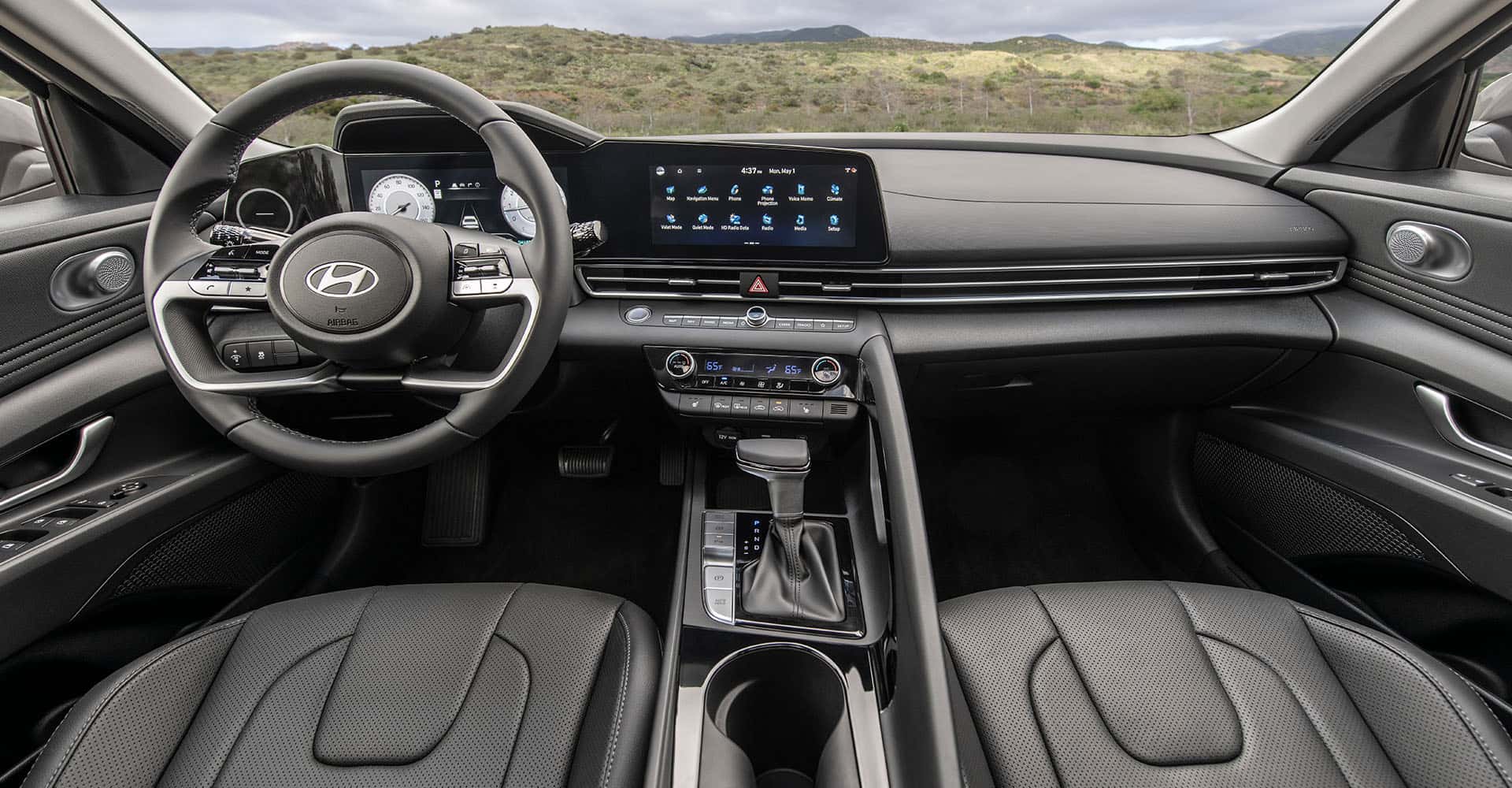
The 1.6 Smart trim already feels premium for its price, with wireless CarPlay, push-start, and rear AC vents. The 2.0 Comfort or GLS adds a more luxurious feel, digital cluster, leather seats, and better insulation, designed for drivers who spend hours on the road.
If you frequently drive from Sharjah to Abu Dhabi, the 2.0’s quiet cabin and extra driver support features make every trip easier.
◊⇒ Suppose you’re considering the Elantra as a family car. In that case, you’ll love our in-depth analysis in the 2025 Hyundai Elantra Full Review, where we explore comfort, safety, and practicality from a family perspective.
Safety & Driver Assistance
| Safety Tech | Elantra 1.6 | Elantra 2.0 |
|---|---|---|
| Airbags | 2 (front) | 6 (standard) |
| ABS + EBD + ESP | Yes | Yes |
| Tire Pressure Monitoring System | Yes | Yes |
| ISOFIX Child Anchors | Standard | Standard |
| Rear Parking Sensors & Camera | Standard (F + R) | 360° Camera and Parking Assist |
| Cruise Control | Standard | Adaptive Cruise Control |
| Lane Keep Assist | Yes | Yes |
| Rear Cross-Traffic Alert | Unavailable | Standard |
Both cars meet the UAE’s safety expectations. Still, the 2.0 offers a full suite of driver-assist features, including blind-spot monitoring and adaptive cruise control, perfect for highway commuting and urban safety compliance under the Road & Transport Authority (RTA) Dubai standards.
◊⇒ To better understand the Elantra’s performance over time, particularly in terms of reliability and recurring issues, refer to our Hyundai Elantra Problem Fixing Guide for detailed insights.
Fuel Efficiency & Mileage Comparison
Published / Official Figures
-
Hyundai Elantra 1.6: 6.5–7.0 L/100 km (14.5 km/L)
-
Hyundai Elantra 2.0: 7.2–7.5 L/100 km (13.3 km/L)
The 1.6 is more economical in tight urban routes, while the 2.0 delivers long-term satisfaction for users valuing acceleration and highway performance.
Real-World UAE Usage
| Driving Mode | 1.6 (Likely Economy) | 2.0 (Likely Economy) |
|---|---|---|
| City / Stop-Go | 13–15 km/L | 12–14 km/L |
| Highway / Cruising | 15–16 km/L | 14–15 km/L |
| Overtaking / Load | Slightly weaker under full load | Stronger pull, more fuel use |
In everyday UAE conditions, the difference is most visible in city traffic. On open highways, the 2.0’s efficiency nearly matches the 1.6, making both practical choices depending on driving style.
Ownership Costs in the UAE
-
Maintenance Intervals: Every 10,000 km (both engines)
-
Insurance Cost Difference: Around AED 400–600 annually
-
Fuel Cost Difference: Minimal unless you drive 2,000 plus km per month
If your driving is mostly within Dubai or Sharjah, the 1.6 saves noticeable fuel over time. If you’re an inter-emirate commuter or prefer effortless overtaking, the 2.0 offers better long-term satisfaction.
What Does It Mean for You as a UAE Buyer?
If you’re upgrading from compact cars like the Toyota Yaris or Honda City, the Hyundai Elantra 1.6 offers affordable comfort, advanced connectivity, and excellent mileage.
For highway commuters, especially those driving between Abu Dhabi and Ras Al Khaimah, the 2.0’s added torque, six airbags, and adaptive cruise control make it a more intelligent long-haul companion.
Hyundai Elantra 1.6 vs 2.0 Competitors in the UAE Market
It competes directly with several popular compact sedans in the UAE that offer a mix of value, efficiency, and comfort. Here’s how they stack up:
| Model | Engine Options | Power Output | Mileage (km/L) |
|---|---|---|---|
| Hyundai Elantra | 1.6L / 2.0L | 126–156 hp | 13–15 |
| Toyota Corolla | 1.6L / 2.0L | 121–168 hp | 14–16 |
| Honda Civic | 1.5L Turbo | 180 hp | 13–15 |
| Nissan Sentra | 1.6L / 1.8L | 118–130 hp | 14–15 |
| Mazda 3 | 2.0L / 2.5L | 153–186 hp | 13–15 |
In comparison, the 1.6 offers the best balance of affordability and efficiency, while the 2.0 competes closely with the Toyota Corolla 2.0 and Mazda 3 2.0 in both power and refinement.
If you prefer a sportier drive, the Honda Civic Turbo delivers more punch, but it comes at a higher cost. For budget-conscious buyers, the Nissan Sentra remains a practical choice but lacks the premium features found in its lineup.
Why the Elantra Still Stands Out
- Better Value for Money: Lower maintenance and insurance costs compared to Civic and Corolla.
- Superior Tech: 10.25″ display, digital cluster, and wireless CarPlay available even in base trims.
- UAE-Ready Comfort: Dual-zone AC, rear vents, and reliable cooling, ideal for desert climates.
Whether you prioritize fuel economy, interior features, or brand reliability, it remains one of the most balanced sedans in its class.
Pros and Cons of Hyundai Elantra 1.6 vs 2.0
Pros
-
Fuel Efficiency: The 1.6L engine delivers excellent mileage for daily city commutes and shorter trips across Dubai and Sharjah.
-
Refined Performance: The 2.0L engine provides smoother acceleration and better torque, ideal for highways like E311 and Sheikh Zayed Road.
-
Modern Design: Both variants feature a “Sensuous Sportiness” design, offering a premium look that rivals pricier sedans.
-
Advanced Technology: Features like a 10.25″ infotainment screen, digital cluster, and wireless CarPlay come standard on most trims.
-
Safety Upgrades: The 2.0 variant offers six airbags, adaptive cruise control, and blind-spot monitoring, enhancing long-distance safety.
-
Low Maintenance Costs: Affordable servicing and readily available parts across the UAE make ownership hassle-free.
Cons
-
Performance Gap: The 1.6 feels slightly underpowered when fully loaded or during high-speed overtaking.
-
Higher Insurance for 2.0: Annual premiums are typically AED 400–600 higher than those for 1.6.
-
Cabin Noise in 1.6: Slightly more road noise compared to the quieter, better-insulated 2.0 variant.
-
Limited Rear Space: Still compact compared to midsize rivals like the Sonata or Camry.
-
Feature Variations: Some advanced features (like adaptive cruise or 360° camera) are exclusive to higher trims.
Frequently Asked Questions
Q: Which engine gives better mileage in UAE conditions?
A: The 1.6L does slightly better in city traffic, while on highways, the difference is minimal, around 0.5 to 1 km/L.
Q: Will the 2.0 variant be much more expensive to maintain?
A: Not really, although it uses a bit more fuel, regular servicing through Hyundai UAE or RTA Dubai helps keep costs steady.
Q: Which version is better for resale in the UAE market?
A: The 1.6 has a broader appeal because it’s more economical, though some buyers still prefer the 2.0 for its stronger performance.
Q: Is the power difference noticeable in everyday use?
A: Yes, especially when overtaking or driving uphill with passengers.
Conclusion
When comparing the Hyundai Elantra 1.6 vs 2.0, it’s not just a numbers game; it’s about your driving style. The 1.6 suits daily commuters who value fuel economy and lower upkeep, while the 2.0 shines for highway drives and those who enjoy a more powerful feel behind the wheel.
Both deliver Hyundai’s signature comfort and reliability, but the real question is: what kind of driver are you?
If you want real-world performance insights, verified reviews, or to check available it listings in Dubai or Abu Dhabi, visit ArabWheels Blog for expert comparisons, maintenance tips, and UAE-spec car guides.
Ready to make your move? Compare trims, explore pricing, and book your test drive today through Hyundai UAE or browse verified listings via ArabWheels.
