
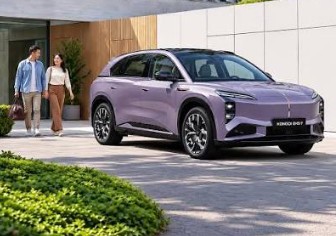
Hongqi EHS7 Solar Roof: What the 300 W Prototype Means
Hongqi’s 300 W perovskite roof prototype could support parked vehicle systems, but its headline 80 km claim belongs to a future body-wide solar concept.

Park an electric car under the UAE sun, and the Hongqi EHS7 solar roof could turn some of that otherwise wasted solar energy into usable electricity instead of cabin heat.
The perovskite solar roof is a full-size photovoltaic prototype integrated into the SUV’s panoramic glass roof. FAW says the system can generate nearly 300 W in sufficient sunlight and produce around 400 kWh of electricity per year.
Those figures sound promising, but they need context. Hongqi has also cited up to 80 km of additional driving per day. However, that estimate does not come from the current 300 W roof. It relates to a future concept with photovoltaic material across a much larger part of the vehicle.
The current 300 W roof does not deliver 80 km of extra range. That figure belongs to Hongqi’s future body-wide solar concept.
What the Hongqi EHS7 Solar Roof Actually Produces
Under suitable sunlight, FAW says the current prototype can generate close to 300 W. The company estimates yearly electricity production at around 400 kWh.
Averaged across a full year, that equals roughly 1.1 kWh per day. Actual output would vary with sunlight, weather, shading, parking position, and temperature.
Hongqi does not position the current system as a replacement for conventional EV charging. Instead, FAW says the solar-generated electricity could support several vehicle functions. These include parked climate control, an on-board refrigerator and vehicle monitoring systems.
That could reduce the amount of energy those systems draw from the main traction battery.
For UAE drivers, conventional charging would still provide most of the vehicle’s energy, so access to reliable EV charging in the UAE remains far more important than solar generation alone.
The 80 km Figure Comes From a Much Bigger Solar System
The more ambitious figure comes from Hongqi’s plans for future vehicle-integrated photovoltaics.
FAW says perovskite solar cells could eventually cover several surfaces, including the roof and bonnet. A larger photovoltaic area would produce far more electricity.
The company estimates that a future system could generate as much as 10 kWh per day. That figure assumes favourable conditions.
Hongqi says this amount of energy could correspond to up to 80 km of driving.
However, this is a manufacturer projection for a future body-wide system. The current panoramic-roof prototype has not demonstrated an 80 km daily range gain.
That distinction matters. Otherwise, readers might assume the existing EHS7 prototype adds 80 km of range each day. Hongqi has not demonstrated that.
The company has also not announced a confirmed production date for the technology.
Hongqi’s 80 km estimate is a future manufacturer projection, not a demonstrated daily range gain from the current EHS7 prototype.
Why Hongqi Chose Perovskite Solar Cells
Hongqi chose perovskite photovoltaic technology instead of a conventional crystalline-silicon panel.
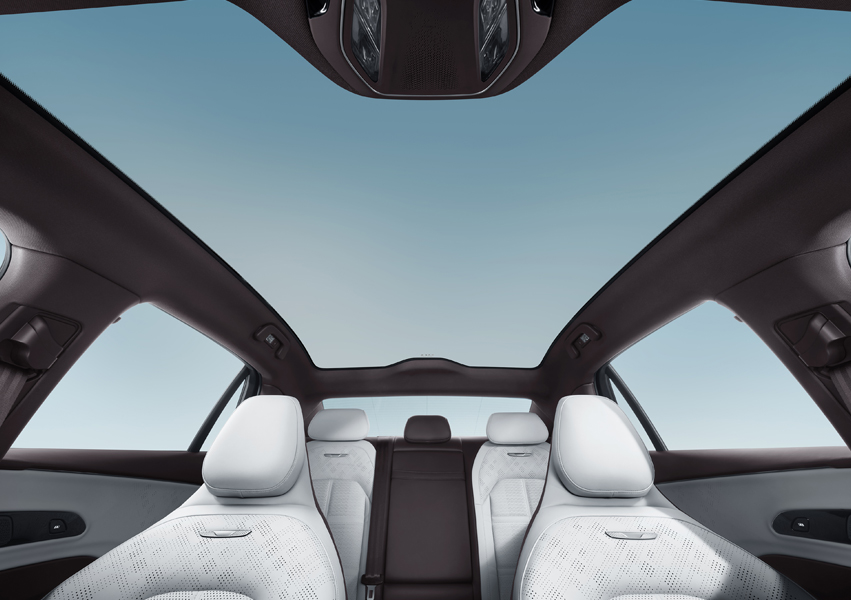
Manufacturers can produce perovskite solar cells in thin and lightweight layers. That makes the technology attractive for curved vehicle surfaces. Conventional rigid panels can be harder to integrate into these areas.
A vehicle roof also creates tougher conditions than a stationary laboratory panel.
FAW says its engineers had to address water, oxygen, and ultraviolet exposure. They also worked on sealing and curved-glass integration.
Long-term durability remains an important challenge. Moisture, oxygen, extended light and heat can degrade perovskite photovoltaic materials. Manufacturers therefore need effective protection and encapsulation.
A vehicle must also cope with changing temperatures, road vibration, rain, washing and prolonged sunlight.
Why the UAE Makes This Prototype More Interesting
For UAE readers, the Hongqi EHS7 solar roof may be more useful for supporting parked electrical loads. That could matter more than the headline-grabbing 80 km figure.
Cars in the Emirates can sit in intense sunlight for hours. Their climate-control systems then work hard to cool hot cabins.
A perovskite solar roof could offset part of that auxiliary energy use. In turn, it could preserve some energy in the traction battery.
However, strong sunshine does not guarantee Hongqi’s quoted annual output in the UAE.
Ambient temperature, panel temperature, UV exposure, and shading could all affect solar production. Parking orientation and long-term degradation would also matter.
Hongqi has not published a UAE-specific energy-yield figure for the prototype.
Heat also affects the EV itself. Air conditioning, battery thermal management, and high-speed driving can influence usable range in summer conditions, as explained in ArabWheels’ guide to EV range in UAE heat.
For UAE drivers, the real opportunity may be using solar energy to reduce parked electrical loads rather than adding dramatic amounts of driving range.
The Emirates therefore presents both an opportunity and a challenge for this technology. It offers abundant sunlight, but also intense heat and UV exposure.
EHS7 Range and Power Figures Need Context
The test vehicle is the EHS7 electric SUV. Hongqi sells it as the Tiangong 08 in China.
Hongqi offers the EHS7 with different battery and drivetrain configurations. Therefore, one range or power figure cannot represent the entire line-up.
The 85 kWh rear-wheel-drive version delivers 475 km WLTP. It uses a 253 kW rear motor.
The larger 111 kWh rear-wheel-drive version reaches 600 km WLTP. It uses the same 253 kW rear motor.
All-wheel-drive versions use a 202 kW front motor and 253 kW rear motor. Official WLTP range varies with the battery and drivetrain configuration.
Those figures place the EHS7 among longer-range electric SUVs. However, UAE buyers should look beyond headline range numbers.
Charging access, battery warranty, service support, expected driving patterns and heat performance all affect ownership. ArabWheels covers those wider considerations in its guide to buying electric cars in the UAE.
Can Solar Power Replace EV Charging?
Not with the current prototype.
Even if the Hongqi EHS7 solar roof achieves Hongqi’s estimated 400 kWh annual production, its main role would be supplementary energy rather than replacing a home charger or public charging station.
That does not make the technology irrelevant.
Reducing the energy consumed by parked climate control, monitoring systems, or other auxiliary features could still be useful, particularly in sunny markets. It would also allow an EV to recover small amounts of energy whenever suitable sunlight is available.
The bigger question is whether the energy generated over the vehicle’s lifetime can justify the added manufacturing cost, complexity, and durability requirements.
Durability Will Decide Whether It Reaches Production
Before this solar-roof technology reaches showrooms, Hongqi must prove its long-term durability.
The photovoltaic layer would face heat, UV radiation, moisture, and road vibration. It would also need to withstand temperature cycles and regular washing.
Cost will matter too. Buyers will want to know how much the system adds to the vehicle price. They will also need information about lifespan, repair costs, and replacement.
Hongqi has not confirmed those production details yet.
For now, the Hongqi EHS7 solar roof remains an engineering prototype rather than a self-charging solution. Hongqi has demonstrated nearly 300 W from the current roof. The 80 km figure belongs to a more ambitious future concept with much more photovoltaic surface area.
For UAE drivers, that distinction matters. The realistic benefit may not be dozens of kilometres of free driving each day. Instead, solar energy could reduce some of the power an EV uses while parked.
What do you think of Hongqi’s solar-roof prototype? Could this technology make a meaningful difference for EV owners in the UAE? Share your thoughts in the comments. Keep following the ArabWheels Blog for more UAE EV news, charging updates, new-car technology, and ownership guides.
