
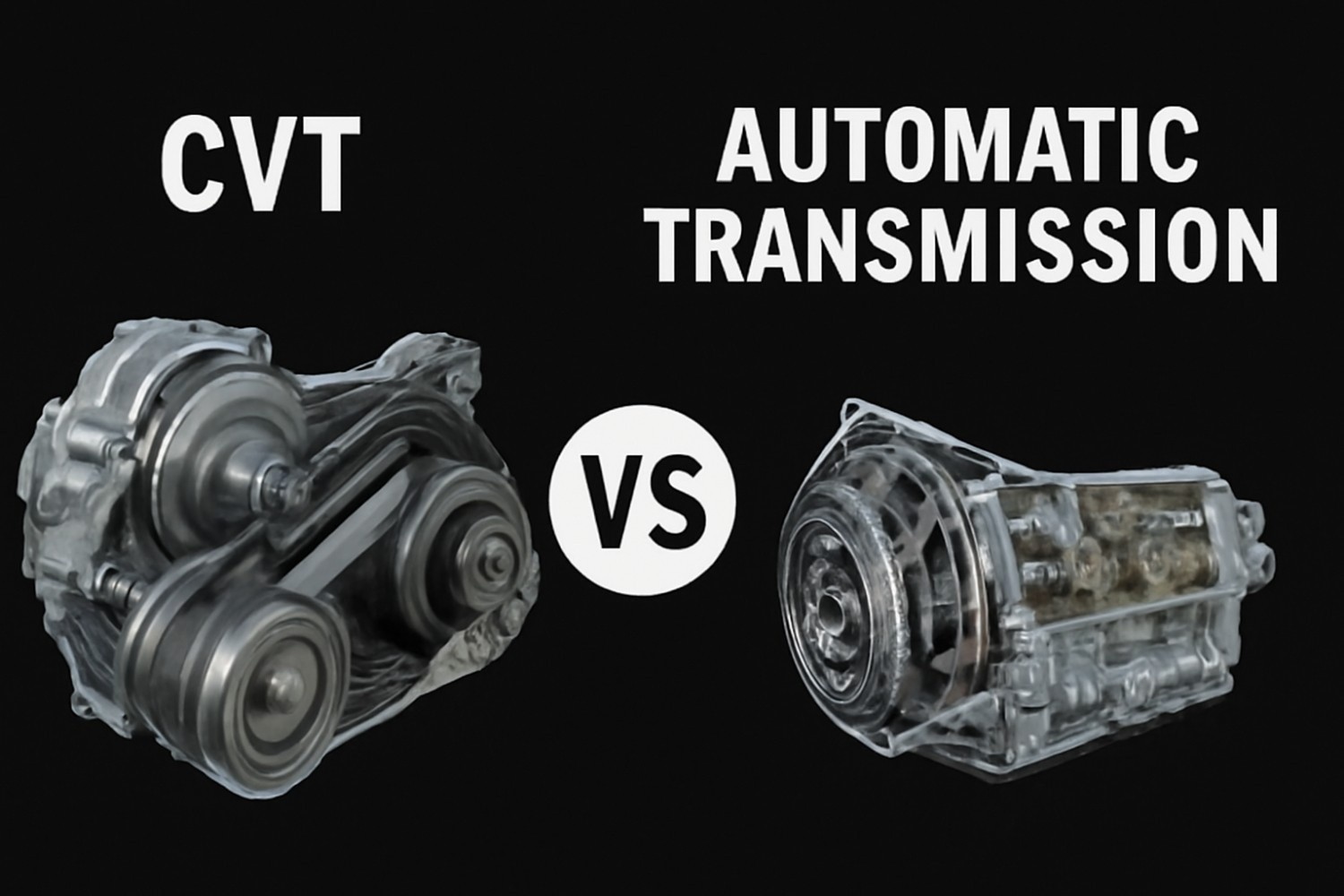
CVT vs Automatic Transmission: What’s the Best Option for You?
Explore the key differences between CVT and automatic transmissions to find the perfect option for your driving style in the UAE.

What Is a Traditional Automatic Transmission?
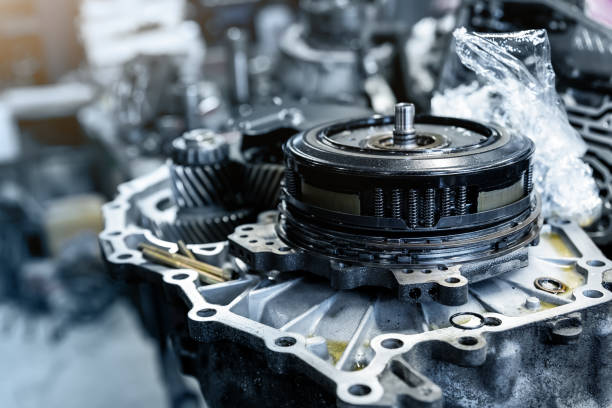
A traditional automatic transmission has been around for decades and is well known for its ability to shift gears without driver input. When you put your vehicle in Drive, the transmission automatically adjusts to changing speeds, selecting from a range of fixed gears (usually 6, 8, or 10) to match engine power with road conditions. This design has evolved significantly over the years, with modern automatic transmissions offering multiple gear ratios to optimize fuel efficiency and performance.
Advantages of Traditional Automatic Transmissions:
-
Greater driver engagement: The distinct feel of shifting gears provides a more involved driving experience.
-
Wider torque range: Capable of handling high torque, making it ideal for larger, more powerful vehicles like trucks or sports cars.
-
Proven reliability: The technology is mature, with repair costs and serviceability relatively low compared to newer systems.
What Is a Continuously Variable Transmission (CVT)?
It offers a smoother driving experience by using a pulley system and a steel belt (or chain) rather than traditional gears. The two pulleys can vary in width, continuously adjusting to deliver an infinite number of gear ratios. This means the engine can operate at its most efficient RPM for any given speed, delivering smoother acceleration without the jolts of gear shifts.
How Does a CVT Work?
-
Pulleys and Belt System: The engine power is transferred through two variable pulleys connected by a steel belt. The pulleys adjust their diameter, offering an infinitely variable range of gear ratios, much like shifting gears on a bicycle.
-
Smooth Operation: There are no distinct gear shifts, which eliminates the “shift shock” or sudden jolts typically associated with traditional automatics.
Advantages of CVTs:
-
Superior fuel efficiency: It helps optimize fuel economy by keeping the engine at its ideal performance level.
-
Smoother acceleration: The absence of gear shifts leads to a smoother driving experience.
-
Lighter and smaller design: It’s typically more compact and lighter than traditional automatic transmissions.

Driving Experience: How Do CVT and Automatic Feel Behind the Wheel?
Driving a Traditional Automatic Transmission:
-
Gear Shifts: Modern automatics have improved significantly, offering smooth, barely perceptible shifts. However, you’ll still feel the shift as the transmission moves between gears.
-
Engagement: The “shift” provides a more connected experience, especially for performance-driven drivers.
Driving a CVT:
-
No Gear Shifts: With it, there are no traditional gear shifts. As you accelerate, the engine’s RPMs increase smoothly, offering consistent power without the “shift shock” of a conventional automatic.
-
Linear Acceleration: Because it can continuously adjust the gear ratio, acceleration feels more linear and predictable.
Pros and Cons: CVT vs Automatic Transmission
Pros of Traditional Automatic Transmissions:
-
More Engaging: If you prefer feeling the shifts as you accelerate, a traditional automatic transmission is ideal.
-
Durability: Automatics are more reliable for handling high-torque applications and demanding driving conditions.
-
Lower Repair Costs: Since automatic transmissions are well-established, repairs tend to be less expensive and easier to manage.
Cons of Traditional Automatic Transmissions:
-
Less Fuel Efficient: While newer automatic transmissions have become more fuel-efficient, they still don’t quite match the efficiency of CVTs in many cases.
-
Heavier and Larger: Automatic transmissions tend to be bulkier and heavier due to their complex gear systems.
Pros of CVT Transmissions:
-
Fuel Economy: The ability to continuously adjust the gear ratio improves fuel economy, making CVTs ideal for smaller cars and hybrids.
-
Smooth Acceleration: The absence of gear changes results in softer, more consistent power delivery.
-
Lighter and Smaller: CVTs typically take up less space, making them ideal for compact cars.
Cons of CVT Transmissions:
-
Less Engaging: Some drivers feel that it’s less fun or engaging to drive because there’s no tactile shift.
-
Potential for “Motorboating”: Under hard acceleration, some of it may cause the engine to rev without a corresponding increase in speed, which can feel unnatural.
-
Higher Repair Costs: It has fewer mechanics trained to service them, making repairs potentially more expensive and more complicated to find.
Which Transmission Is Right for You?
Choose an Automatic Transmission If:
-
You drive a larger vehicle (e.g., a truck or SUV) or require high torque.
-
You prefer a more traditional, engaging driving experience.
-
Durability and lower repair costs are your top priorities.
Choose a CVT If:
-
Fuel efficiency is your primary concern.
-
You drive a smaller or hybrid car.
-
You value a smooth, uninterrupted driving experience.
Frequently Asked Questions (FAQs)
Q1: Do CVTs last as long as automatic transmissions?
A: While CVTs are a newer technology, they can last as long as traditional automatics if appropriately maintained. However, they may require more specialized care, and some models have experienced reliability issues in the past.
Q2: Can I drive a CVT like an automatic?
A: Yes! Many modern CVTs allow drivers to select simulated gear shifts, making the driving experience feel more like an automatic transmission. However, this may reduce the efficiency benefits of the CVT.
Q3: Are CVTs more expensive to repair than automatic transmissions?
A: Yes, repairs can be more expensive because fewer mechanics are trained to service them. Additionally, some parts may be more costly to replace.
Conclusion
Choosing between the two really comes down to your driving needs. If you’re mostly navigating city traffic and want something smooth and fuel-efficient, a CVT is likely your best bet. It offers seamless gear shifts and better fuel economy, making it ideal for daily commutes. However, if you’re after a more engaging driving experience, especially on highways or when you need a transmission that handles higher torque with ease, a traditional automatic might be the right choice.
Whatever you decide, it’s essential to consider factors like fuel efficiency, performance, and long-term maintenance costs to ensure you choose the best vehicle for your next purchase. For more insights on CVT vs Automatic Transmission and expert advice, check out ArabWheels. Explore more on the ArabWheels blog for additional details!
