
Chinese Car Trends 2026: Why UAE Expansion Is Accelerating
China’s export push is accelerating as domestic sales weaken, giving UAE buyers more choice across SUVs, hybrids, EVs and premium models.

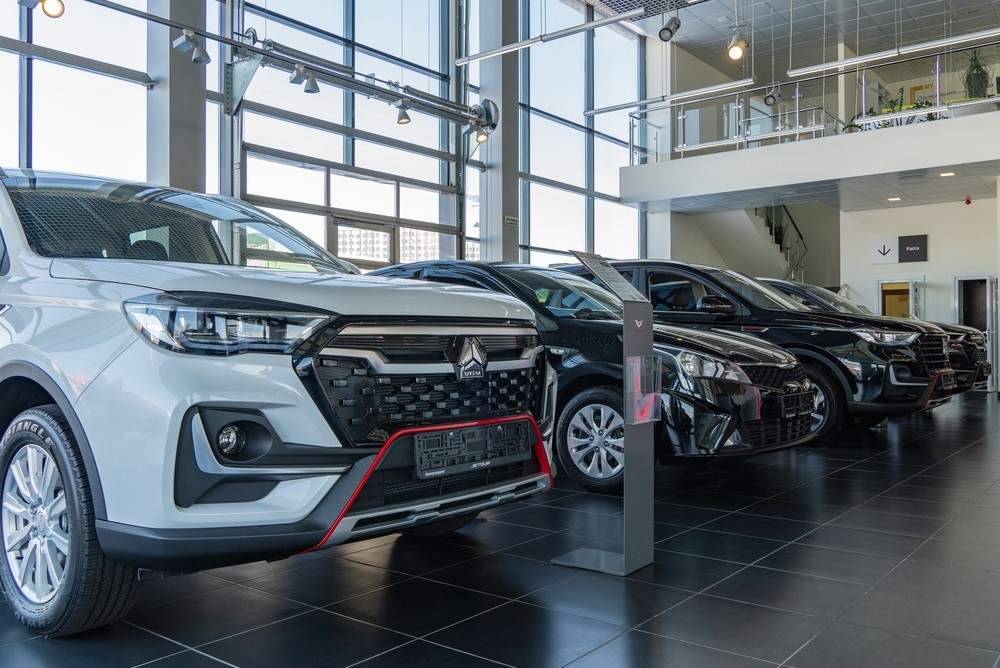
Walk through a UAE showroom today, and the change is difficult to miss. Chinese car brands in the UAE are no longer confined to one corner of the market. From family crossovers to premium EVs, Chinese car trends in 2026 now reflect a much broader push for buyers who once defaulted to Japanese, Korean or European brands.
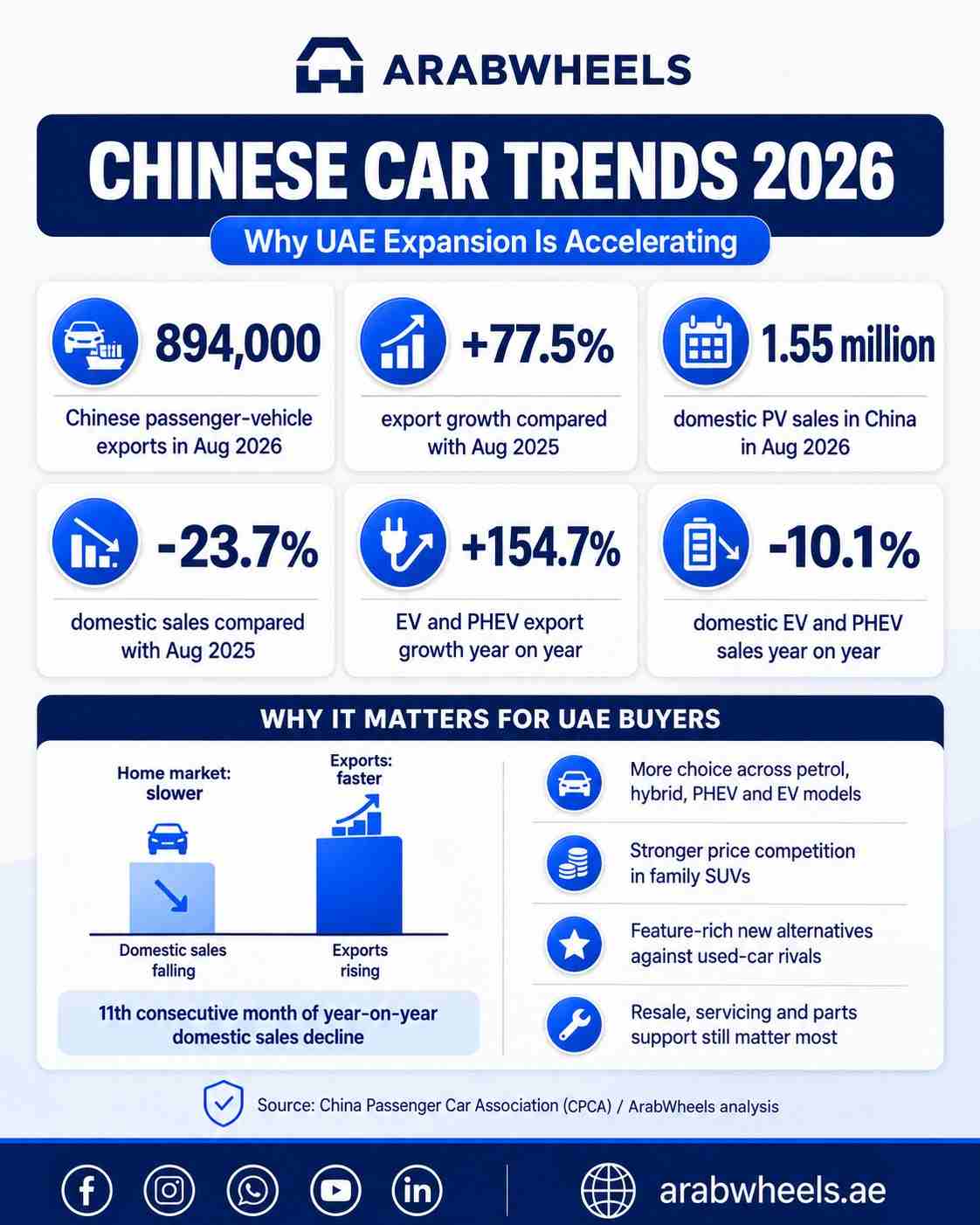
The timing is not accidental. Chinese passenger-vehicle exports reached 894,000 units in August, up 77.5% year on year. At home, sales fell 23.7% to 1.55 million vehicles, marking an 11th consecutive month of year-on-year decline. Exports of EVs and plug-in hybrids climbed even faster, rising 154.7%.
For UAE buyers, that changes the conversation. The issue is no longer whether Chinese brands are gaining visibility. It is what their expansion means for price, choice, resale and ownership after the first year.
China’s Slowing Home Market Is Sending Cars Abroad
The immediate pressure is coming from China’s domestic market.
Domestic EV and plug-in hybrid sales fell 10.1% year on year in August, while exports from the same category more than doubled. BYD and Geely also recorded new export highs, reinforcing their position among China’s largest car manufacturers. Cui Dongshu, secretary-general of the China Passenger Car Association, expects Chinese vehicle exports to reach around 12 million units in 2026.
With domestic sales falling, overseas growth is becoming increasingly important to Chinese manufacturers.
Competition remains intense at home, while falling domestic sales are pushing Chinese carmakers to accelerate their overseas expansion. That shift is a major factor shaping Chinese car trends in 2026, and the UAE fits naturally into the strategy because manufacturers can sell petrol cars, hybrids, PHEVs and full EVs in the same market.

The export push is not without scrutiny. Chinese regulators have already warned manufacturers against repeated overseas price cuts and other practices that could damage consumer confidence or long-term brand value.
So the next phase is not simply about shipping more cars. It is about proving that those cars can build a sustainable business outside China.
Why Chinese Carmakers Are Pushing Harder Into the UAE
The UAE gives Chinese manufacturers access to buyers across a wide range of price points.
A manufacturer can enter with an affordable family crossover, add a plug-in hybrid SUV above it, then move into premium EV territory without leaving the same country.
Chinese brands are also moving beyond the budget end of the market, another important development shaping Chinese car trends in 2026.
The UAE also sits at the centre of a wider regional automotive trade network. The growing number of Chinese car brands in Dubai reflects that role, with the emirate serving both local buyers and wider trade flows. Cars arriving through UAE ports can serve local demand as well as re-export channels, so import figures should never be treated automatically as local registrations.
Still, the commercial appeal is clear: a relatively small market gives manufacturers access to buyers across several price brackets and, at the same time, a gateway into the wider Gulf.
Price Opened the Door. Features Are Keeping It Open
The first wave of Chinese cars often sold on price. The newer wave is harder to dismiss so quickly.
Adaptive cruise control, blind-spot monitoring, surround-view cameras, autonomous emergency braking and large digital displays are now available on a growing number of Chinese models sold in the UAE.
Hybrid and plug-in hybrid choices are also becoming easier to find.
Together, those changes are reshaping the comparisons buyers make in the showroom.
In some price brackets, buyers may find a new Chinese SUV competing for the same budget as a used Japanese or Korean alternative, while also offering a new-car warranty and a long standard-equipment list.

A longer feature list looks impressive on delivery day, but its appeal can fade if servicing, insurance or depreciation increase long-term ownership costs.
The ‘Cheap Chinese Car’ Label Is Wearing Thin
The idea that Chinese cars compete mainly on low prices no longer reflects the full UAE market.
Chinese manufacturers now sell affordable crossovers, large off-road SUVs, high-output PHEVs and premium electric cars. Some still compete aggressively on entry price. Others are chasing customers who previously looked almost exclusively at established premium brands.
Once a Chinese model moves beyond the value end of the market, it has to compete on more than specification sheets. Buyers expect better materials, stronger refinement, convincing performance, and aftersales support that matches the higher price.
Moving upmarket, however, requires more than a higher price and a longer equipment list; buyers also expect the ownership experience to match.
The Middle of the SUV Market Is Where the Fight Gets Serious
The strongest pressure may be felt in mainstream family SUVs.
This is where Chinese crossovers increasingly meet established Japanese and Korean rivals head-on. Price still helps, but electrified powertrains and generous standard features are becoming important selling points too.

The established brands, however, carry advantages built over decades.
Buyers know where to service them. Independent garages understand them. Used-car buyers recognise the names. Parts supply and resale behaviour are easier to judge because the market has seen those models for years.
Chinese brands have to close that confidence gap while keeping the value that attracted buyers in the first place.
For shoppers, that competition is useful. More credible alternatives at the same budget make it easier to reject a weak offer rather than buy simply because a familiar badge feels safer.
Resale Is Where Confidence Still Gets Tested
New-car value is easy to advertise. Future resale is not.
Resale performance varies widely among Chinese brands, and many newer models still have too little UAE used-market history for confident long-term residual-value comparisons.
A model backed by a strong UAE distributor, a growing owner base, and steady used-car demand may behave very differently from one that entered the country only recently.
Mileage, accident history, service records and remaining warranty matter too.
Buyers should therefore judge resale at model level rather than by country of origin; “Chinese cars have bad resale” is too broad. Promising strong residual values for a model with only a short UAE history is equally difficult to defend.
The sensible question is narrower: how much demand exists for this exact model when it is two or three years old?
The Showroom Sale Is Only Half the Test
A showroom can sell excitement in an afternoon. Ownership lasts much longer.
By the third or fourth year, spare-parts availability, workshop capacity and warranty handling can matter more than a panoramic display or another driver-assistance feature.

A seven-year warranty may sound generous, for example, but buyers still need to know what it covers, whether it transfers to the next owner and how easy it is to use locally.
The same goes for service access. A competitive purchase price matters less if the local distributor cannot provide convenient workshop access or timely parts support.
This is where distributor strength starts to separate cars that looked equally convincing during the test drive.
China’s Strongest Advantage Is Now Electrified
The fastest-growing part of the export story is not conventional petrol cars.
Chinese EV and plug-in hybrid exports rose 154.7% year on year in August, far faster than overall passenger-vehicle exports.
The rapid growth of electrified exports is another defining part of Chinese car trends in 2026, giving manufacturers a larger international product pipeline from which to expand their UAE ranges.
PHEVs may be especially relevant for drivers who want electric running for shorter journeys but still need a petrol engine for longer trips between emirates.
Range figures alone should not determine the purchase.
Charging access, battery warranty, real-world consumption and daily mileage matter more than the headline range. A PHEV makes sense when its owner can actually use the electric side of the powertrain rather than carrying a battery that rarely gets charged.
Final Verdict: Chinese Brands Are Forcing a Better Comparison
The real story behind Chinese car trends in 2026 is not simply that more Chinese badges are appearing on UAE roads.
China’s slower home market is pushing manufacturers to look outward just as UAE buyers are becoming more willing to consider alternatives across mainstream SUVs, premium cars and electrified models.
That gives shoppers more choice, but it also demands better judgement.
The strongest deal is not automatically the lowest price, the longest warranty or the biggest screen. It is the car that still makes sense when servicing, insurance, parts support and resale enter the calculation.
The more meaningful change is that Chinese cars are increasingly being judged against established rivals on the full ownership proposition. Chinese brands are no longer fighting merely for attention from UAE buyers. They are now being compared more seriously with established rivals.
Read more ArabWheels coverage of Chinese brands, new-car launches, ownership costs and UAE market trends.
