
China Built an EV Shield to Neutralize Global Oil Shocks
When the Middle East shipping crisis pushed oil prices upward in June 2026, global markets braced for severe disruption. Yet petrol stations across major Chinese cities remained surprisingly calm throughout this sharp international energy price spike.
Rapid electrification in transport has weakened the extent to which shifts in crude prices immediately strain China’s oil demand. However, electric vehicles alone did not insulate the nation from wider energy market fluctuations and macroeconomic vulnerabilities.
The economic relationship between global crude markets and Chinese road transport has undergone a permanent structural shift. China remains the largest crude importer globally, but road transportation no longer consumes fuel at historic rates.
While EVs provide a strong buffer, overall resilience stems from broader industrial conditions and strategic petroleum reserves.
EVs Changed China’s Fuel-Demand Equation
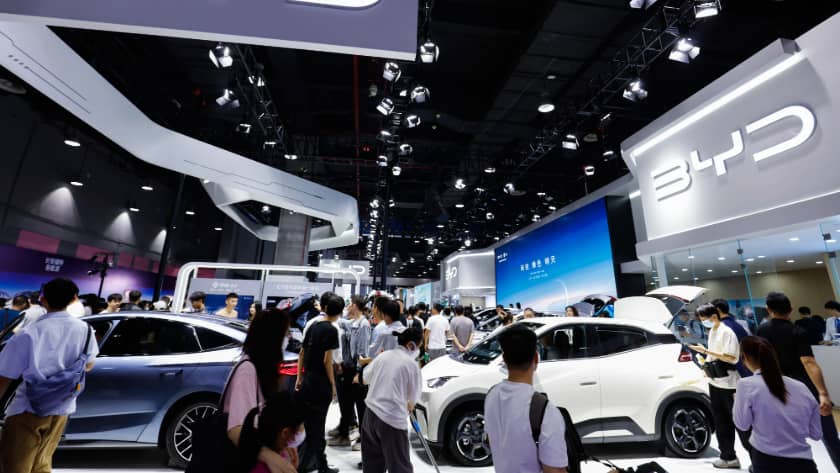
In June 2026, electrified models captured roughly 62% of all new passenger car sales in China. This broad new energy vehicle category includes both pure battery-electric cars and plug-in hybrid electric vehicles.
Pure battery electrics accounted for 36%, while plug-in hybrids made up the remaining market share. Because plug-in hybrids still consume petrol on longer trips, total fuel displacement requires careful analytical measurement.
Reuters reports Chinese gasoline demand in October 2025 Golden Week dropped 9% from the previous year, with Sinopec predicting over a 4% decline for the year. Estimates from the International Energy Agency (IEA) indicate that Chinese electrification displaces 1 million barrels of crude oil daily.
Higher pump prices have naturally accelerated this transition by convincing budget-conscious commuters to abandon combustion engines completely.
Electric Trucks Matter More Than Their Fleet Size Suggests
While passenger cars draw consumer headlines, heavy commercial vehicles have a disproportionate impact on national diesel consumption. Industry data cited by the Associated Press showed that battery-electric models captured 22% of heavy-truck sales.
Long-haul logistics fleets accumulate immense annual mileage, making diesel displacement per vehicle significantly higher than passenger cars. Rapid adoption of commercial transport electrification continues to alter long-term projections for China’s oil demand.
Swappable battery infrastructure has removed lengthy charging delays, enabling heavy commercial trucks to maintain rigorous operational schedules. The International Energy Agency noted that swap-capable trucks accounted for 15% of electric truck sales recently.
Municipal bus fleets and urban delivery vans have also achieved near-total electrification across major Chinese metropolitan regions.
How China EV Oil Demand Fits Into the Broader Buffer
Attributing lower crude import figures solely to road fleet electrification ignores several critical macroeconomic and industrial factors. Customs records indicated that crude imports dropped by over 40% year over year during the June 2026 shipment disruptions.
As reported by Reuters, domestic refiners simultaneously reduced processing rates due to weak industrial margins and quotas. Slower economic activity in the construction sector, combined with expanded high-speed rail networks, further reduced overall petroleum requirements.
Strategic crude inventories built during earlier low-price periods allowed Chinese refiners to draw down domestic stockpiles temporarily. Public transport utilization increased significantly as urban commuter networks expanded across tier-2 and tier-3 regional cities.
Consequently, transport electrification operated alongside industrial shifts rather than acting as a single isolated defensive shield.
Electricity Reduces One Dependency but Creates Others
Shifting energy demand from imported oil to the electrical grid creates distinct supply chain and operational vulnerabilities. EVs shift transport demand onto an electricity system that still depends heavily on coal, even as renewable generation expands rapidly.
Furthermore, advanced battery manufacturing depends on complex global supply chains for critical minerals and specialized semiconductor equipment. Petrochemical manufacturing, commercial aviation, and maritime shipping sectors still require massive volumes of imported crude oil daily.
National power grids remain vulnerable to domestic weather extremes, regional capacity constraints, and shortages of industrial equipment. Therefore, replacing imported petroleum with domestic power generation reduces maritime risk without establishing complete economic energy immunity.
Gulf oil exporters monitoring these developments must track how China’s oil demand evolves across heavy commercial sectors.
What Other Oil Importing Nations Can Learn
Developing economies across Asia and the Middle East are evaluating China’s strategic framework for road transport electrification. Accelerating fleet electrification requires massive upfront capital investments in charging infrastructure, power generation, and grid distribution networks.
Gulf economies are also investing in EV manufacturing and charging infrastructure, although their policy objectives differ from China’s because several are major oil exporters rather than import-dependent economies.
Commercial vehicle fleets offer the fastest return on investment for nations seeking immediate reductions in domestic fuel consumption.
Conclusion
Fleet electrification has demonstrably softened China’s road transport vulnerability to sudden international petroleum market price shocks. Lower daily fuel consumption provides structural resilience, but it does not eliminate broader geopolitical and economic energy risks.
China’s long-term trajectory confirms that electrification acts as a partial buffer rather than a total shield. Regional energy planners must look past dramatic claims to understand the balanced reality of transport transformation.
Will the shift toward commercial fleet electrification in Asian markets force Gulf oil exporters to reshape their long-term refining and export strategies? Follow ArabWheels Blog for our upcoming market behavior analysis and GCC energy trade updates.